
Illinois city guide
Moving From California to Arlington Heights, IL
A large northwest suburb with a genuine downtown, deep housing inventory across price points, and strong high schools.
Housing comparison
California versus Arlington Heights, side by side
- Median home value
- $725,800
- $403,200
- Median annual property tax
- $5,114
- not available
- Median monthly cost, owners with a mortgage
- $2,844
- not available
- Population
- 39.0 million (state)
- 76,220
Figures are US Census Bureau American Community Survey 2020 to 2024 5-Year Estimates for the city place. Property tax and monthly cost rows cover owner-occupied units with a mortgage, so they describe what current owners pay, not what a new buyer would pay at today's prices. California column is the statewide baseline used across this site.
Why Californians look at Arlington Heights
Arlington Heights sits about 25 miles northwest of the Loop and is one of the larger, more built-out suburbs in Cook County, with a walkable downtown centered on its Metra station and a housing stock broad enough to cover starter condos through large single-family homes on a single town's map. That range is the town's main appeal for relocating families who want options without moving between towns as budget or family size changes.
The high schools, particularly those in Township High School District 214, have a strong regional reputation, and the district's scale means a wide range of programs, from career and technical pathways to advanced coursework, that a smaller district often cannot support.
For a California family, Arlington Heights offers a more conventional, less expensive path into the northwest suburbs than Naperville or the North Shore, with a real downtown and direct Metra service into the city as the differentiators from a purely car-dependent suburb.
Arlington Heights fits you if
- You want strong public high schools with broad program offerings.
- You want deep inventory across price points in one town rather than needing to compare several suburbs.
- You want Metra service into Chicago from a walkable downtown.
- You want a large, established suburb with mature parks, libraries, and municipal services.
Look elsewhere if
- You want a small-town feel. Arlington Heights is a large, built-out suburb with a big population.
- You want new construction. Most of the housing stock dates from the postwar decades through the 1990s.
- You want to avoid Illinois property taxes, which remain high here as elsewhere in Cook County.
- You need a short commute without traffic. The northwest suburbs carry real congestion on their arterial roads and expressways.
Housing in Arlington Heights
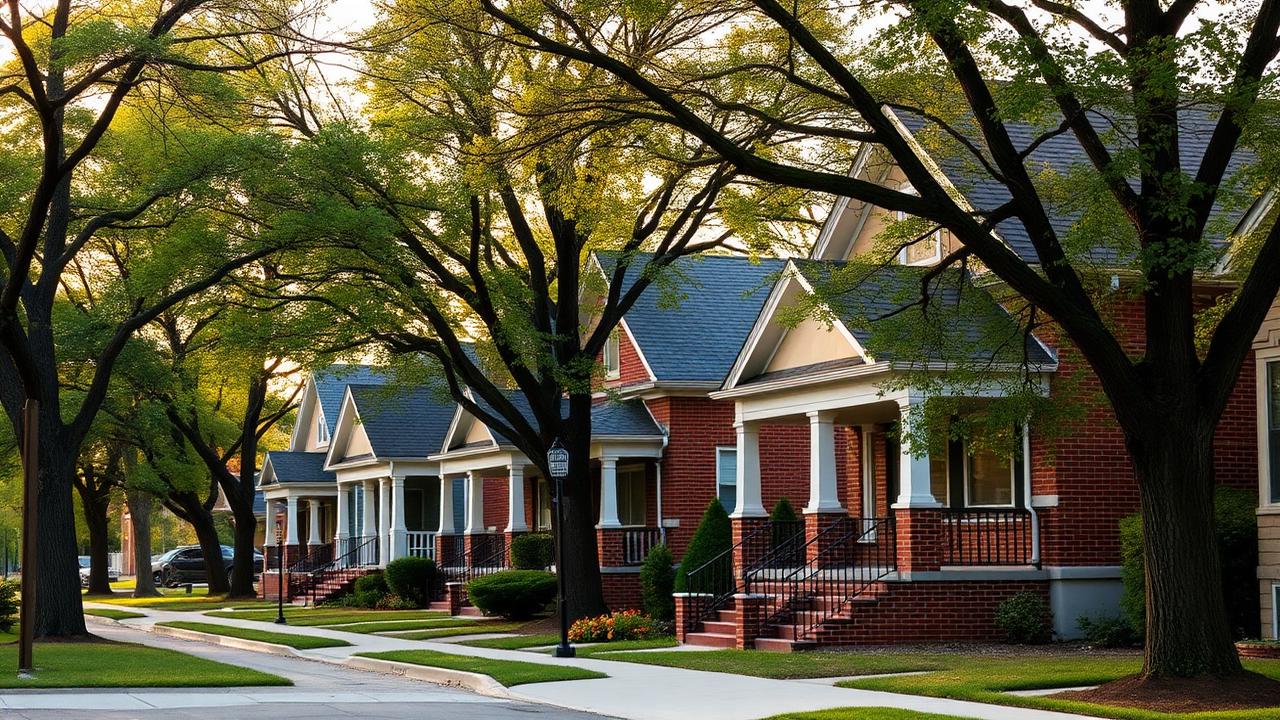
The housing stock spans postwar ranches and split-levels, larger 1970s and 1980s subdivisions, downtown condos and townhomes near the Metra station, and pockets of newer infill construction, which is what gives the town its range across price points.
The median home value is $403,200, below Naperville and Evanston, which makes Arlington Heights a relatively more accessible entry point into the northwest Chicago suburbs while still carrying Illinois's high property tax burden and Cook County's own layered rates.
Because inventory spans such a wide range, buyers can often find a workable home here even when a specific school boundary or price ceiling rules out other suburbs.
Work and the local economy
Arlington Heights functions primarily as a bedroom community, with the largest local employment coming from healthcare, retail, and the school district itself, plus a Metra-connected downtown of restaurants and small offices.
Many residents commute into Chicago via Metra's Union Pacific Northwest Line, while others work in the broader O'Hare-adjacent corporate corridor that runs through the northwest suburbs.
As with the other suburbs profiled here, the relevant labor market for most households is the wider Chicago metro rather than the town's own limited employment base.
Climate
Arlington Heights shares the Chicago area's full four-season climate, with humid summers, colorful autumns, and cold, snowy winters running from December through March.
Being inland rather than lakefront, it avoids the more intense lake-effect snow bands that hit the North Shore, though it still receives the same regional winter storm systems.
Spring brings a real severe weather season, including thunderstorms and occasional tornado watches across the broader Chicago region, which is worth knowing for a Californian unfamiliar with tornado sirens.
Getting around, care, and schools
- Commercial air
- O'Hare International Airport is about 10 miles southeast, one of the closest suburbs on this list to a major airport.
- Rail transit
- Metra Union Pacific Northwest Line runs from downtown Arlington Heights into Chicago.
- Highways
- Interstates 90 and 290 and Illinois Route 53 serve the area.
- Hospital
- Northwest Community Hospital is based in Arlington Heights.
- Public schools
- Multiple elementary districts feed into Township High School District 214.
- Higher education
- Harper College, a large community college, is in nearby Palatine.
- Setting
- Northwest Chicago suburb about 25 miles from the Loop.
The trade-offs
- Being this close to O'Hare means aircraft noise is a real factor in some neighborhoods.
- Illinois and Cook County property tax rates apply here as elsewhere in the metro.
- Traffic on Route 53 and the northwest expressways can be heavy at peak commuting hours.
- Most housing is decades old rather than new, so buyers should budget for updates to mechanicals and finishes.
Other Illinois towns people compare
Naperville
A large, affluent Chicago suburb built around its schools and its Metra line, and the default landing spot for relocating families.
Evanston
A lakefront, transit-connected suburb anchored by Northwestern University, the closest Chicago-area equivalent to a college town like Berkeley.
Oak Park
An inner-ring, architecturally significant suburb directly on the Chicago border, with an el line into the Loop and a long history of intentional integration.
Peoria
A downstate Illinois river city with genuinely low housing costs, a regional hospital system, and an engineering and manufacturing employment base built around Caterpillar.
Galena
A small historic river town in Illinois's northwest hill country, popular with second-home buyers and retirees rather than working households.
Statewide figures, tax detail, and the full Illinois picture are on the Illinois page. Compare property, income, and sales tax across all 49 destination states on Taxes, and see where Californians are actually moving on Stats.
Sources
- US Census Bureau, American Community Survey 2020 to 2024 5-Year Estimates, table B25077 (median home value), retrieved via Census Reporter, September 3, 2026.
- US Census Bureau, ACS 2020 to 2024 5-Year Estimates, table B25103 (median real estate taxes paid, owner-occupied units with a mortgage), retrieved September 3, 2026.
- US Census Bureau, ACS 2020 to 2024 5-Year Estimates, table B25088 (median selected monthly owner costs, owner-occupied units with a mortgage), retrieved September 3, 2026.
- US Census Bureau, ACS 2020 to 2024 5-Year Estimates, table B01003 (total population), retrieved September 3, 2026.
- Township High School District 214, d214.org.
- Northwest Community Healthcare, nch.org.
See what your California equity buys in Arlington Heights
Four short questions. We match you with one local agent and apply a closing cost credit funded from our referral fee.
Start your Arlington Heights move
Four short questions. We use them to decide which agent fits your move, and to build your equity report.