
Louisiana city guide
Moving From California to Lafayette, LA
The largest city in Acadiana, with the strongest local economy outside Baton Rouge and New Orleans and a cultural identity distinct from the rest of the state.
Housing comparison
California versus Lafayette, side by side
- Median home value
- $725,800
- $257,000
- Median annual property tax
- $5,114
- not available
- Median monthly cost, owners with a mortgage
- $2,844
- not available
- Population
- 39.0 million (state)
- 122,273
Figures are US Census Bureau American Community Survey 2020 to 2024 5-Year Estimates for the city place. Property tax and monthly cost rows cover owner-occupied units with a mortgage, so they describe what current owners pay, not what a new buyer would pay at today's prices. California column is the statewide baseline used across this site.
Why Californians look at Lafayette
Lafayette is the capital of Cajun and Creole Louisiana, a mid-sized city with a food, music, and festival culture that outweighs its population. It sits in the flat prairie country of Acadiana, about two and a half hours west of New Orleans and an hour east of Lake Charles.
The local economy has historically tracked the oil and gas industry, since Lafayette served as a hub for offshore energy services in the Gulf. That link has loosened somewhat as the city has diversified into healthcare, education, and a growing technology sector, but energy still moves the local mood more than in Baton Rouge or Shreveport.
For a Californian, Lafayette offers a genuinely distinct regional culture, cheaper housing than the coasts, and a food scene that punches well above the city's size. It does not offer coastal weather, a major international airport, or the job diversity of a larger metro.
Lafayette fits you if
- You want a strong, specific regional culture, food, and music scene rather than a generic Sunbelt suburb.
- You want a more diversified local economy than a single-industry Louisiana town, with healthcare and education alongside energy.
- You are comfortable with a flat, humid, low-lying landscape rather than mountains or coastline.
- You want proximity to both New Orleans and the Gulf coast without living directly on either.
Look elsewhere if
- You need a major international airport nearby. Lafayette Regional has limited service compared to Houston or New Orleans.
- You are sensitive to the oil and gas boom-bust cycle and want an economy insulated from it.
- You dislike heat, humidity, and heavy rainfall for much of the year.
- You need advanced specialty medical care beyond what a mid-sized regional hospital system provides.
Housing in Lafayette
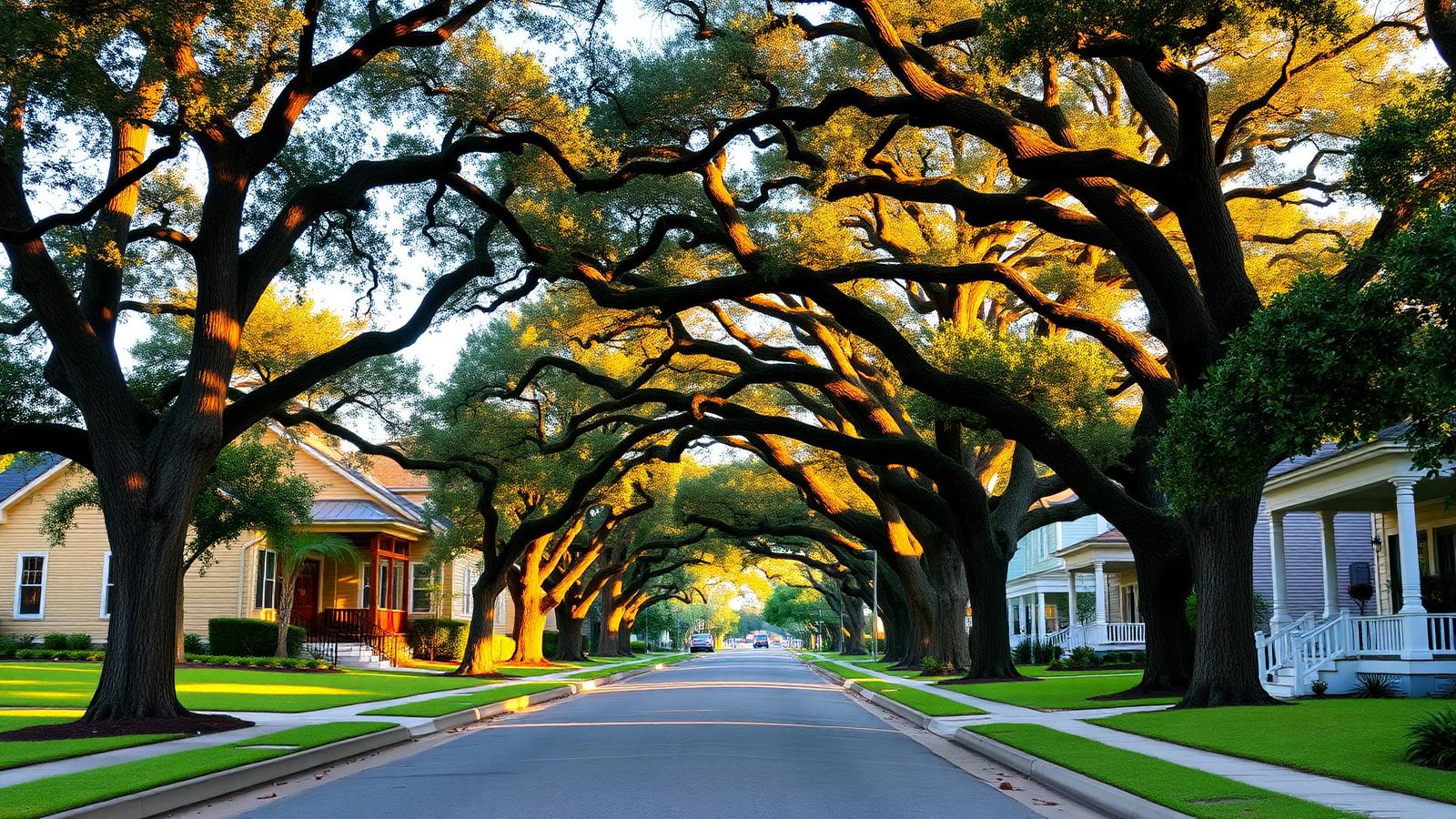
Lafayette's housing ranges from historic Creole cottages and shotgun houses near downtown, to ranch-style subdivisions from the oil-boom decades, to newer development toward Youngsville and Broussard on the city's southern edge, which have absorbed much of the recent growth.
The ACS median home value for the city is $257,000, a fraction of the California statewide median. Prices have risen steadily over the past decade but remain well within reach of a buyer bringing equity from a California sale.
As with the rest of low-lying south Louisiana, flood zone and drainage history matter for any specific address. Some Lafayette neighborhoods took on water during the 2016 flood event that hit much of the region, so check flood maps and ask about drainage before buying.
Work and the local economy
Oil and gas services have anchored Lafayette's economy for decades, particularly firms supporting offshore Gulf of Mexico production. That base has shrunk and become more volatile as offshore activity has declined from its peak, and locals are candid about the boom-bust pattern.
Healthcare is now a major stabilizer, led by Ochsner Lafayette General and Our Lady of Lourdes Regional Medical Center, along with the University of Louisiana at Lafayette, which anchors education and a growing research and technology presence.
A household bringing remote income avoids the cyclical risk entirely. A household planning to work locally in energy should understand that the industry here has contracted meaningfully since its mid-2010s peak.
Climate and setting
Lafayette has a humid subtropical climate similar to the rest of south Louisiana. Summers are hot and humid with highs typically in the low 90s, and winters are short and mild with occasional cold snaps.
The city sits on flat prairie land west of the Atchafalaya Basin, with no meaningful elevation change and slow-draining terrain that makes heavy rain events a recurring concern.
Hurricane season brings indirect exposure. Lafayette is inland enough to avoid storm surge but still takes tropical rainfall, wind, and the occasional direct hit, as Hurricane Laura's outer bands demonstrated in 2020.
Getting around, care, and schools
- Commercial air
- Lafayette Regional Airport (LFT) offers limited direct service to Dallas, Houston, Atlanta, and Charlotte.
- Highways
- Interstate 10 and Interstate 49 cross the city.
- Hospital
- Ochsner Lafayette General and Our Lady of Lourdes Regional Medical Center.
- Public schools
- Lafayette Parish School System.
- Higher education
- University of Louisiana at Lafayette.
- Setting
- Flat prairie country in Acadiana, roughly 130 miles west of New Orleans.
The trade-offs
- The economy still carries meaningful exposure to oil and gas services, an industry that has contracted from its peak.
- Air service is thin. Many longer trips mean connecting through Houston or New Orleans.
- Flat, slow-draining terrain makes drainage and flood history a real factor in choosing a specific neighborhood.
- Humidity and heat run from late spring through early fall, similar to the rest of the Gulf South.
Other Louisiana towns people compare
Baton Rouge
Louisiana's capital and second-largest city, built on state government and the petrochemical corridor along the Mississippi River, far enough inland to cut hurricane exposure without eliminating it.
Shreveport
Louisiana's third-largest city, tucked into the state's northwest corner on the Texas and Arkansas borders, with no hurricane exposure and the lowest home prices among the state's real cities.
Mandeville
A north shore suburb on Lake Pontchartrain, roughly 40 minutes from New Orleans, widely regarded as the preferred family suburb in the metro for its schools and lower flood exposure.
New Orleans
Louisiana's largest city and cultural capital, with music, food, and architecture unmatched anywhere else on this list, paired with the highest insurance costs and flood exposure in the state.
Statewide figures, tax detail, and the full Louisiana picture are on the Louisiana page. Compare property, income, and sales tax across all 49 destination states on Taxes, and see where Californians are actually moving on Stats.
Sources
- US Census Bureau, American Community Survey 2020 to 2024 5-Year Estimates, table B25077 (median home value), retrieved via Census Reporter, September 3, 2026.
- US Census Bureau, ACS 2020 to 2024 5-Year Estimates, table B25103 (median real estate taxes paid, owner-occupied units with a mortgage), retrieved September 3, 2026.
- US Census Bureau, ACS 2020 to 2024 5-Year Estimates, table B25088 (median selected monthly owner costs, owner-occupied units with a mortgage), retrieved September 3, 2026.
- US Census Bureau, ACS 2020 to 2024 5-Year Estimates, table B01003 (total population), retrieved September 3, 2026.
- CensusEasy, Lafayette, Louisiana demographics and housing data, censuseasy.com.
- Lafayette Regional Airport route information, lftairport.com.
See what your California equity buys in Lafayette
Four short questions. We match you with one local agent and apply a closing cost credit funded from our referral fee.
Start your Lafayette move
Four short questions. We use them to decide which agent fits your move, and to build your equity report.