
Pennsylvania city guide
Moving From California to Pittsburgh, PA
A hilly, river-cut city rebuilt around medicine, education, and robotics, with among the lowest home prices of any major US metro.
Housing comparison
California versus Pittsburgh, side by side
- Median home value
- $725,800
- $205,800
- Median annual property tax
- $5,114
- not available
- Median monthly cost, owners with a mortgage
- $2,844
- not available
- Population
- 39.0 million (state)
- 304,759
Figures are US Census Bureau American Community Survey 2020 to 2024 5-Year Estimates for the city place. Property tax and monthly cost rows cover owner-occupied units with a mortgage, so they describe what current owners pay, not what a new buyer would pay at today's prices. California column is the statewide baseline used across this site.
Why Californians look at Pittsburgh
Pittsburgh is the rare major American city where a California household's home equity can buy a house outright and still leave money over. The city sits at the confluence of three rivers, wrapped around dozens of distinct hillside neighborhoods, and it carries a genuine urban infrastructure, an airport, professional sports, museums, a symphony, at a fraction of coastal pricing.
The economy that replaced steel is built on UPMC and Allegheny Health Network in medicine, on Carnegie Mellon University and the University of Pittsburgh in research and robotics, and on a growing base of tech and autonomous-vehicle work that grew directly out of those universities. It is not a boomtown, but it is diversified in a way most former industrial cities are not.
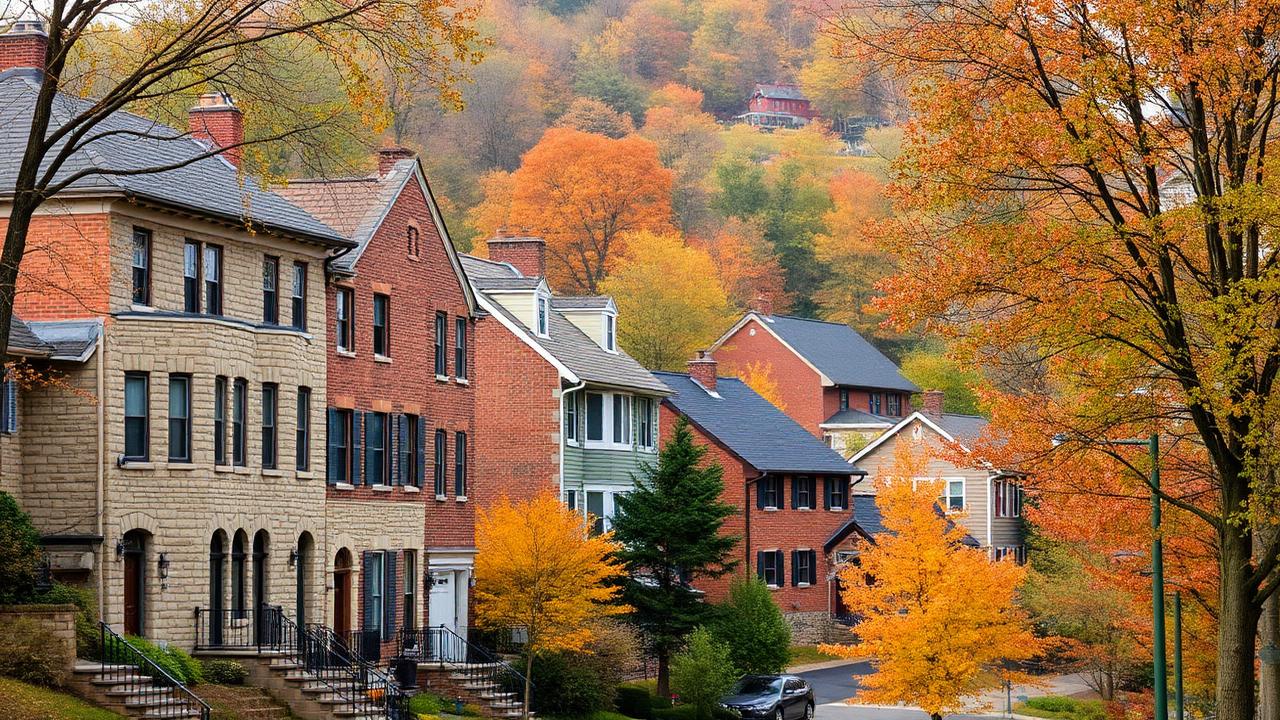
The terrain and the age of the city are what surprise newcomers most. Streets follow hillsides rather than a grid, many neighborhoods are separated by rivers and bridges rather than roads, and winters bring real snow and gray stretches that a Southern California household should plan for rather than discover.
Pittsburgh fits you if
- You work in healthcare, biotech, robotics, or software and want a lower cost of living without leaving a research-university ecosystem.
- You want walkable, distinct urban neighborhoods rather than sprawl, at prices far below the coasts.
- You are buying with California equity and want a paid-off or near paid-off home in a full-service city.
- You do not mind hills, bridges, and a real winter in exchange for the price and the amenities.
Look elsewhere if
- You need mild, sunny weather year-round. Pittsburgh has a humid continental climate with genuine winters and frequent overcast stretches.
- You dislike driving or walking on steep grades. Much of the city's terrain is hillside.
- You want a booming, high-growth job market. Pittsburgh's economy is stable rather than fast-growing.
- You need frequent long-haul nonstop flights from a hub-scale airport.
Housing in Pittsburgh
Housing stock ranges from dense brick rowhouses in neighborhoods like Lawrenceville and Bloomfield, to large early twentieth-century homes in Squirrel Hill and Shadyside, to newer construction in outlying neighborhoods and suburbs. Many older homes need updated wiring, plumbing, or foundation work, so a careful inspection matters more here than in newer Sun Belt construction.
The ACS median home value for the city is $205,800, well below the national median and a small fraction of California's statewide figure. Neighborhood-to-neighborhood variation is large: riverfront and university-adjacent areas cost noticeably more than the city average, while parts of the East End and the North Side remain considerably cheaper.
Property is assessed and taxed by the city, county, and school district separately, and Allegheny County's assessment system has been the subject of ongoing legal disputes over accuracy, so buyers should confirm the current assessed value on any specific property rather than assume it matches the sale price.
Work and the local economy
UPMC is the largest employer in the region by a wide margin, anchoring a healthcare sector that includes Allegheny Health Network and a dense network of hospitals and research institutions. Carnegie Mellon University and the University of Pittsburgh supply both employment and a steady stream of engineering and computer science graduates who feed local robotics and software firms.
That academic base has pulled in autonomous-vehicle and robotics work from companies that set up Pittsburgh offices specifically to hire from CMU, along with a smaller but real financial services and corporate presence including PNC and Highmark.
The tradeoff is that Pittsburgh's job market rewards specific fields, healthcare, research, software, education, more than broad-based commerce. A household with a portable income or a fit in one of those sectors will do well; a household hoping for a wide-open general labor market should look elsewhere.
Climate and terrain
Pittsburgh has a humid continental climate with four distinct seasons. Winters bring regular snow and long stretches of overcast skies, summers are warm and humid with real thunderstorms, and spring and fall are the most pleasant stretches of the year.
The city is genuinely hilly, built on bluffs above three rivers, and many neighborhoods are connected by bridges, tunnels, and inclines rather than flat streets. Driving here takes some adjustment, and a house with a flat, easy driveway is not something to take for granted.
Air quality has improved dramatically since the steel era, but the Ohio River valley's topography can still trap haze on still days, and the region occasionally shows up on national air quality watch lists during particular weather patterns.
Getting around, care, and schools
- Commercial air
- Pittsburgh International Airport (PIT) offers domestic service and a growing but still limited set of international routes.
- Highways
- Interstates 79, 76, 279, and 376 converge in and around the city.
- Hospital
- UPMC Presbyterian and Allegheny General Hospital anchor a deep regional hospital network.
- Public schools
- Pittsburgh Public Schools, plus numerous independent suburban districts just outside city limits.
- Higher education
- University of Pittsburgh and Carnegie Mellon University, both within the city.
- Setting
- Hillside city at the confluence of the Allegheny, Monongahela, and Ohio rivers.
The trade-offs
- Winters are real, with regular snow and long gray stretches that differ sharply from a California winter.
- Terrain makes some commutes and errands slower than the mileage suggests. Hills, bridges, and tunnels shape traffic patterns.
- The job market rewards healthcare, research, and software specifically rather than offering broad general employment.
- Older housing stock means more inspection and maintenance diligence than newer construction requires.
Other Pennsylvania towns people compare
Lancaster
A small, walkable historic city in Pennsylvania Dutch Country, with rising demand from East Coast buyers priced out of Philadelphia.
Bethlehem
A Lehigh Valley city built on a preserved steel-era core, now anchored by healthcare, education, and a casino and arts complex on the old Bethlehem Steel site.
State College
A university borough in the geographic center of the state, its economy and housing market insulated by Penn State's flagship campus.
Doylestown
The Bucks County seat, a small historic borough with a commuter rail line to Philadelphia and collar-county pricing well above the rest of the region.
Erie
Pennsylvania's only Great Lakes city, with the lowest home prices in this guide and some of the heaviest lake-effect snow in the eastern United States.
Statewide figures, tax detail, and the full Pennsylvania picture are on the Pennsylvania page. Compare property, income, and sales tax across all 49 destination states on Taxes, and see where Californians are actually moving on Stats.
Sources
- US Census Bureau, American Community Survey 2020 to 2024 5-Year Estimates, table B25077 (median home value), retrieved via Census Reporter, September 3, 2026.
- US Census Bureau, ACS 2020 to 2024 5-Year Estimates, table B25103 (median real estate taxes paid, owner-occupied units with a mortgage), retrieved September 3, 2026.
- US Census Bureau, ACS 2020 to 2024 5-Year Estimates, table B25088 (median selected monthly owner costs, owner-occupied units with a mortgage), retrieved September 3, 2026.
- US Census Bureau, ACS 2020 to 2024 5-Year Estimates, table B01003 (total population), retrieved September 3, 2026.
- UPMC and Allegheny Health Network employment and facility information, upmc.com and ahn.org.
- Pittsburgh International Airport route map, flypittsburgh.com.
See what your California equity buys in Pittsburgh
Four short questions. We match you with one local agent and apply a closing cost credit funded from our referral fee.
Start your Pittsburgh move
Four short questions. We use them to decide which agent fits your move, and to build your equity report.