
Massachusetts city guide
Moving From California to Amherst, MA
Home to UMass Amherst and Amherst College, a Five College town with a stable rental market and a rural western Massachusetts setting, well removed from Boston.
Housing comparison
California versus Amherst, side by side
- Median home value
- $725,800
- not available
- Median annual property tax
- $5,114
- not available
- Median monthly cost, owners with a mortgage
- $2,844
- not available
- Population
- 39.0 million (state)
- 38,182
Figures are US Census Bureau American Community Survey 2020 to 2024 5-Year Estimates for the city place. Property tax and monthly cost rows cover owner-occupied units with a mortgage, so they describe what current owners pay, not what a new buyer would pay at today's prices. California column is the statewide baseline used across this site.
Why Californians look at Amherst
Amherst is defined by its colleges. UMass Amherst, the flagship campus of the state university system, and Amherst College, a highly selective liberal arts school, sit within a few miles of each other and together with Hampshire College anchor the town's economy, culture, and housing market.
The setting is rural western Massachusetts, all rolling farmland, woods, and small town centers, a sharp contrast to both greater Boston and to California's coastal or valley development patterns. Northampton is a short drive away for a denser downtown experience.
For a California household, Amherst offers a genuine college-town intellectual and cultural life, a large and unusually stable rental market driven by student housing demand, and no state income tax advantage since Massachusetts does tax income, but overall living costs still well under the eastern part of the state.
Amherst fits you if
- You want to be near a major research university and a top liberal arts college.
- You are interested in the rental market as an investment; student demand keeps occupancy stable.
- You want a rural, green setting with farms and conservation land close by.
- You are affiliated with UMass Amherst, Amherst College, or the broader Five College system.
Look elsewhere if
- You want an urban or even a dense small-city setting; Amherst center is small and much of the town is rural.
- You need to commute to Boston regularly; it is roughly two hours away.
- You want a broad private-sector job market outside education.
- You dislike a college-town rhythm, with population and traffic shifting with the academic calendar.
Housing in Amherst
Amherst's population is 38,182, a figure that includes a large student population that swells and shrinks with the academic calendar. Housing near both campuses is dominated by rental units serving students and staff, while single-family neighborhoods further from campus serve the year-round resident population.
The rental market here is unusually stable and in many years tight, driven by consistent University of Massachusetts and Amherst College enrollment, which makes Amherst a market some out-of-state buyers consider specifically for rental income rather than only as a primary residence.
Home prices and property tax rates are set in the context of a town with substantial protected farmland and conservation restrictions on development, which limits new supply and supports values even though the town is well outside the high-price eastern Massachusetts market.
Work and the local economy
UMass Amherst is by a wide margin the largest employer in the region, with Amherst College and Hampshire College adding further education-sector jobs. Together the Five College consortium is the dominant force in the local labor market.
Beyond education, the local economy runs on the services, restaurants, and retail that support a large student population, plus agriculture on the area's remaining working farms.
As in nearby Northampton, the private-sector job market outside education and agriculture is limited, so a household needs a university affiliation, portable income, or a willingness to commute toward Springfield or Hartford for other kinds of work.
Climate and setting
Amherst sits in the Pioneer Valley in western Massachusetts, with a climate defined by real winters, regular snow from December through March, and cold snaps typical of inland New England away from any coastal moderation.
Summers are warm and humid, generally in the low-to-mid 80s, and the surrounding farmland and hills make for a scenic growing season, with local farm stands and orchards a genuine part of daily life.
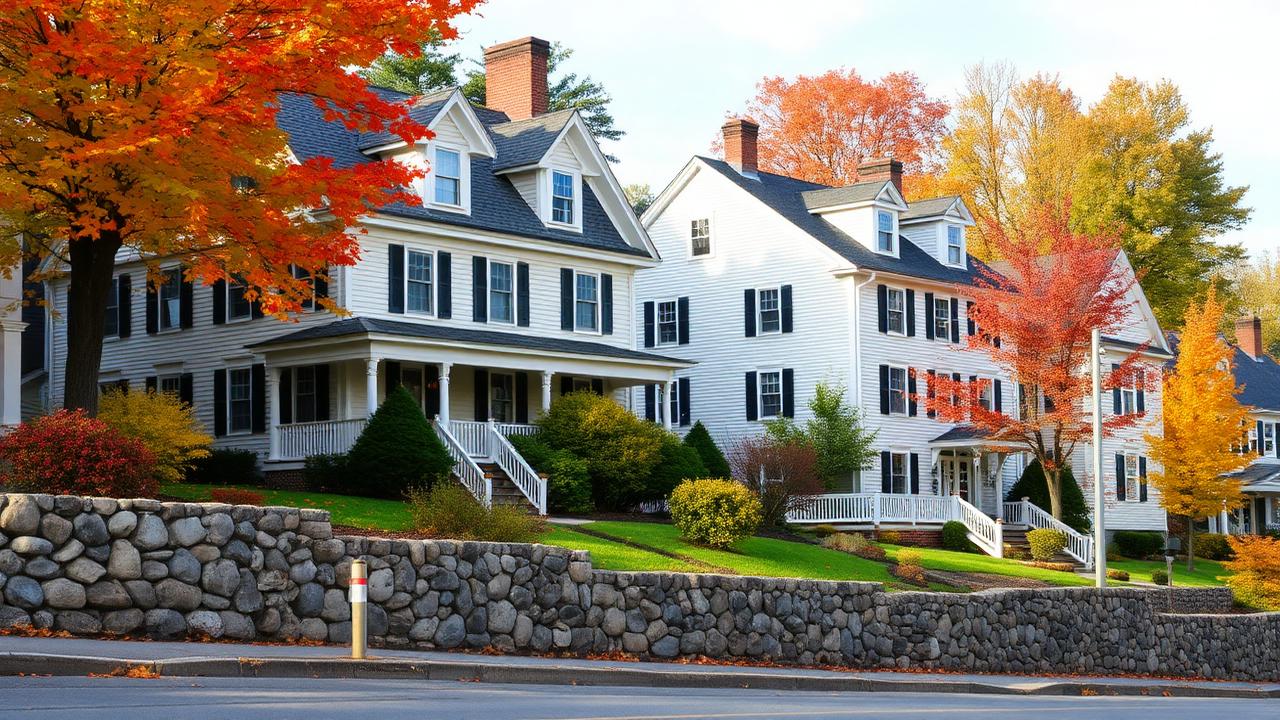
Fall foliage is a defining seasonal event in the Pioneer Valley, drawing visitors to the surrounding hill towns, and the academic calendar means the town's population and character shift noticeably between semester and summer break.
Getting around, care, and schools
- Commercial air
- Bradley International Airport, near Hartford, Connecticut, about an hour south, is the practical regional airport.
- Highways
- Interstate 91 runs through the Pioneer Valley a short drive west of town center.
- Hospital
- Cooley Dickinson Hospital in nearby Northampton is the primary regional hospital.
- Public schools
- Amherst-Pelham Regional School District.
- Higher education
- UMass Amherst and Amherst College are both in town; Hampshire College, Mount Holyoke College, and Smith College are all nearby.
- Setting
- Rural Pioneer Valley, western Massachusetts.
The trade-offs
- The local job market outside education is thin; portable income or a university affiliation is the practical foundation.
- Boston is roughly two hours away, ruling out a regular commute.
- The town's population and traffic shift with the academic calendar, which some residents find disruptive.
- Protected farmland limits new housing supply, which supports values but also limits choice for buyers.
Other Massachusetts towns people compare
Worcester
The state's second largest city, an hour west of Boston by highway or commuter rail, with a growing hospital and biotech sector and prices well under the eastern Massachusetts market.
Northampton
A Pioneer Valley college city built around Smith College, walkable and culturally active, well west of Boston and priced far below the eastern part of the state.
Newburyport
A restored seaport downtown on the Merrimack River, about 40 miles north of Boston with direct commuter rail, popular with out-of-state buyers and priced accordingly.
Quincy
A dense city on Boston's southern edge with its own MBTA Red Line stations, offering Boston access at a discount to the city itself, still a real premium by national standards.
Plymouth
A large, spread-out coastal town best known for Plymouth Rock, offering bigger lots and lower prices than towns closer to Boston at the cost of a long commute.
Statewide figures, tax detail, and the full Massachusetts picture are on the Massachusetts page. Compare property, income, and sales tax across all 49 destination states on Taxes, and see where Californians are actually moving on Stats.
Sources
- US Census Bureau, American Community Survey 2020 to 2024 5-Year Estimates, table B25077 (median home value), retrieved via Census Reporter, September 3, 2026.
- US Census Bureau, ACS 2020 to 2024 5-Year Estimates, table B25103 (median real estate taxes paid, owner-occupied units with a mortgage), retrieved September 3, 2026.
- US Census Bureau, ACS 2020 to 2024 5-Year Estimates, table B25088 (median selected monthly owner costs, owner-occupied units with a mortgage), retrieved September 3, 2026.
- US Census Bureau, ACS 2020 to 2024 5-Year Estimates, table B01003 (total population), retrieved September 3, 2026.
- Census Reporter, Amherst Town, MA profile, censusreporter.org.
- UMass Amherst and Amherst College employment and enrollment information, umass.edu and amherst.edu.
See what your California equity buys in Amherst
Four short questions. We match you with one local agent and apply a closing cost credit funded from our referral fee.
Start your Amherst move
Four short questions. We use them to decide which agent fits your move, and to build your equity report.