
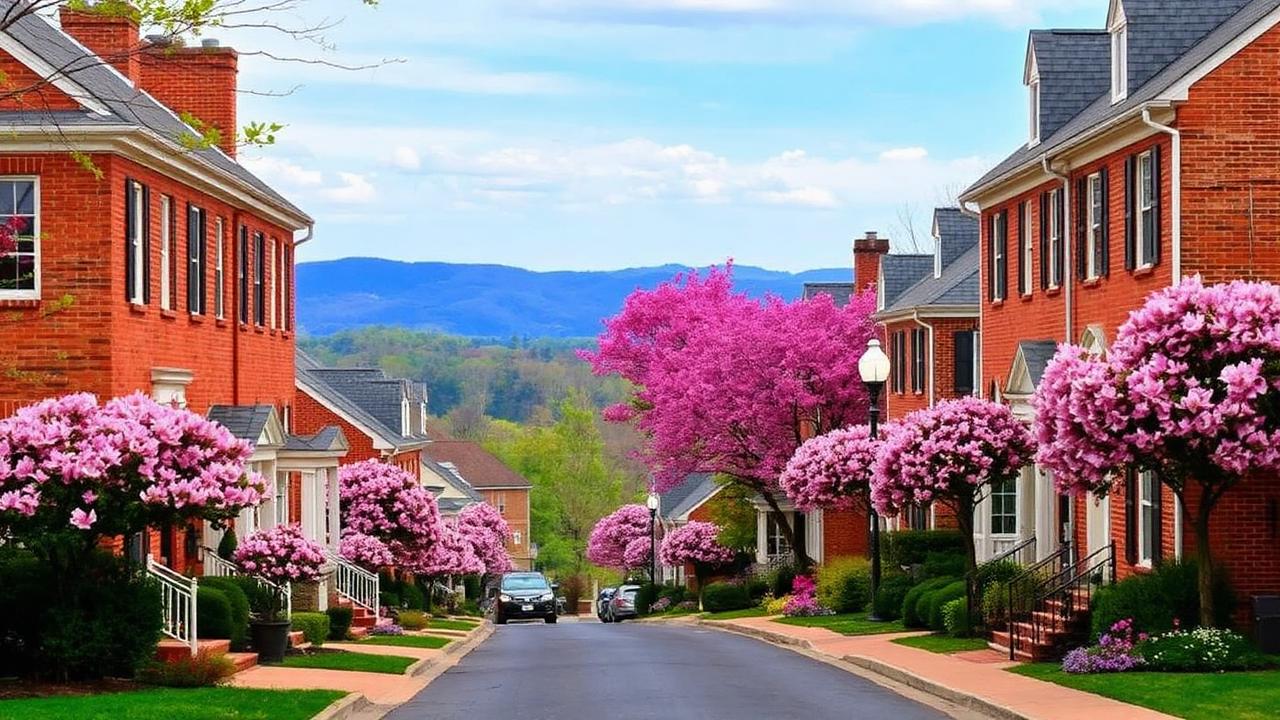
Virginia city guide
Moving From California to Fredericksburg, VA
A historic small city halfway between Washington, D.C. and Richmond, with VRE commuter rail access and lower prices than the inner Northern Virginia suburbs.
Housing comparison
California versus Fredericksburg, side by side
- Median home value
- $725,800
- $483,700
- Median annual property tax
- $5,114
- not available
- Median monthly cost, owners with a mortgage
- $2,844
- not available
- Population
- 39.0 million (state)
- 28,873
Figures are US Census Bureau American Community Survey 2020 to 2024 5-Year Estimates for the city place. Property tax and monthly cost rows cover owner-occupied units with a mortgage, so they describe what current owners pay, not what a new buyer would pay at today's prices. California column is the statewide baseline used across this site.
Why Californians look at Fredericksburg
Fredericksburg sits on the Rappahannock River roughly halfway between Washington, D.C. and Richmond, a position that has made it a genuine commuter option for federal and Northern Virginia jobs without Northern Virginia prices. Virginia Railway Express commuter trains run from Fredericksburg into Washington's employment core, a real alternative to driving Interstate 95.
The city itself is compact, with a well-preserved historic downtown along the river dating to the colonial and Civil War eras, surrounded by newer residential growth in Spotsylvania and Stafford counties that has made the broader area one of the faster-growing parts of the state.
For a California household that needs occasional access to Washington, D.C. for work but does not want to pay Northern Virginia prices, Fredericksburg offers a genuine middle path, at the cost of a long commute if that access needs to be daily.
Fredericksburg fits you if
- You need periodic access to Washington, D.C. by VRE commuter rail without living in the expensive inner suburbs.
- You want a walkable historic downtown with real Civil War and colonial-era history.
- You want lower prices than Northern Virginia while staying within striking distance of federal employment.
- You want river access and proximity to both Richmond and D.C. metro amenities.
Look elsewhere if
- You need a daily D.C. commute with a short travel time. VRE and I-95 trips run well over an hour each way.
- You want a large, diverse local job market. Much of Fredericksburg's workforce commutes elsewhere for higher-paying jobs.
- You need a major hospital system in town. Specialty care beyond the local hospital usually means a drive to Richmond or D.C.
- You want a quiet, low-growth area. Surrounding Spotsylvania and Stafford counties have grown quickly and carry real traffic on I-95.
Housing in Fredericksburg
The compact historic city has colonial and Victorian-era homes near downtown and the river, while most newer housing growth, including large subdivisions, sits in surrounding Spotsylvania and Stafford counties, which is where most VRE commuters actually live.
The ACS median home value for the city is $483,700, higher than Richmond or Roanoke and reflecting Fredericksburg's position within commuting range of Washington, D.C. Prices in the surrounding counties vary but generally track the region's commuter demand.
Because this is a commuter market, home values here are more closely tied to Washington-area job growth and interest rates than to the local Fredericksburg economy itself.
Work and the local economy
A significant share of the working population commutes out of the area, to federal jobs, defense contracting, and other employment in Washington, D.C., Northern Virginia, and Quantico Marine Corps Base, which is nearby.
Locally, healthcare through Mary Washington Healthcare, retail, and the service businesses supporting the growing residential population make up much of the on-the-ground job base within the city and surrounding counties.
A household not commuting to Washington or working remotely should research the local job market carefully, since much of the area's higher-paying employment is genuinely elsewhere.
Climate and setting
Fredericksburg has a humid subtropical climate typical of the Virginia Piedmont, with hot, humid summers and generally mild winters that bring occasional snow and ice, sometimes complicated further by I-95 traffic during storms.
The Rappahannock River runs through the historic downtown, giving the city a walkable waterfront and parkland that many residents use for recreation.
Its inland position gives it less hurricane exposure than the coast, though heavy rain from tropical remnants can still cause river flooding in low-lying downtown areas.
Getting around, care, and schools
- Commercial air
- No major commercial airport in the city; Washington Dulles and Reagan National, about an hour north, are the practical airports.
- Highways
- Interstate 95 runs through the area; US 1 and US 17 provide local connections.
- Hospital
- Mary Washington Hospital, the area's main hospital.
- Public schools
- Fredericksburg City Public Schools within the city; Spotsylvania and Stafford counties operate separate districts.
- Higher education
- University of Mary Washington.
- Setting
- Historic river city on I-95, roughly halfway between Washington, D.C. and Richmond.
The trade-offs
- A daily Washington, D.C. commute by VRE or car is long, generally well over an hour each way.
- Much of the area's higher-paying work is genuinely elsewhere, in D.C., Northern Virginia, or at Quantico.
- I-95 traffic through the region is heavy and can affect both commuting and everyday errands.
- Specialty medical care beyond Mary Washington Hospital usually means a drive to Richmond or the D.C. area.
Other Virginia towns people compare
Richmond
Virginia's capital, a real city with historic neighborhoods, a growing finance and government job base, and the best housing value of any Virginia metro.
Charlottesville
A university town anchored by the University of Virginia, surrounded by wine country and the Blue Ridge, and the most desirable small city in the state.
Roanoke
The largest city in southwest Virginia, built around the Blue Ridge and a regional healthcare and logistics economy, at Appalachian prices.
Virginia Beach
Virginia's largest city, a coastal community built around a major military presence, oceanfront tourism, and a broad regional job base.
Williamsburg
A small, retiree-heavy historic city built around Colonial Williamsburg and the College of William and Mary, with steady demand from out-of-state buyers.
Statewide figures, tax detail, and the full Virginia picture are on the Virginia page. Compare property, income, and sales tax across all 49 destination states on Taxes, and see where Californians are actually moving on Stats.
Sources
- US Census Bureau, American Community Survey 2020 to 2024 5-Year Estimates, table B25077 (median home value), retrieved via Census Reporter, September 3, 2026.
- US Census Bureau, ACS 2020 to 2024 5-Year Estimates, table B25103 (median real estate taxes paid, owner-occupied units with a mortgage), retrieved September 3, 2026.
- US Census Bureau, ACS 2020 to 2024 5-Year Estimates, table B25088 (median selected monthly owner costs, owner-occupied units with a mortgage), retrieved September 3, 2026.
- US Census Bureau, ACS 2020 to 2024 5-Year Estimates, table B01003 (total population), retrieved September 3, 2026.
- Data USA, Fredericksburg, VA profile, datausa.io.
- Virginia Railway Express schedule and station information, vre.org.
See what your California equity buys in Fredericksburg
Four short questions. We match you with one local agent and apply a closing cost credit funded from our referral fee.
Start your Fredericksburg move
Four short questions. We use them to decide which agent fits your move, and to build your equity report.