
Nebraska city guide
Moving From California to Kearney, NE
A central Nebraska hub city on Interstate 80, built around the University of Nebraska at Kearney and a regional hospital, with some of the lowest entry prices in the state.
Housing comparison
California versus Kearney, side by side
- Median home value
- $725,800
- $244,600
- Median annual property tax
- $5,114
- not available
- Median monthly cost, owners with a mortgage
- $2,844
- not available
- Population
- 39.0 million (state)
- 34,246
Figures are US Census Bureau American Community Survey 2020 to 2024 5-Year Estimates for the city place. Property tax and monthly cost rows cover owner-occupied units with a mortgage, so they describe what current owners pay, not what a new buyer would pay at today's prices. California column is the statewide baseline used across this site.
Why Californians look at Kearney
Kearney sits almost exactly in the middle of Nebraska on Interstate 80, roughly midway between Omaha and the Colorado border, and functions as the retail, medical, and educational hub for a large surrounding rural region rather than as a suburb of anything larger.
The University of Nebraska at Kearney and CHI Health Good Samaritan, a regional referral hospital, are the city's two dominant institutions, and together with the school district and local government they account for a large share of stable local employment.
For a California household prioritizing low cost above all else, Kearney is close to the floor for a full-service Nebraska city: a real hospital, a university, chain retail, and a walkable-enough historic downtown, all at prices well under even Omaha's already low median.
Kearney fits you if
- You want the lowest realistic entry price for a full-service Nebraska city with a hospital and a university.
- You are retiring or bringing remote income and do not need a deep or varied local job market.
- You want a slower-paced, small-city environment with a university's cultural offerings layered on top.
- You value being roughly equidistant to Denver and Omaha for occasional big-city trips.
Look elsewhere if
- You need frequent commercial flights. Kearney's air service is minimal and Omaha or Denver, both roughly two and a half hours away, are the practical airports.
- You need a deep or specialized local job market outside healthcare, education, retail, and agriculture-related business.
- You want cultural and dining variety beyond what a city of about 34,000 can support.
- You want proximity to a major metro for daily commuting; Kearney is genuinely rural-adjacent, not a suburb.
Housing in Kearney
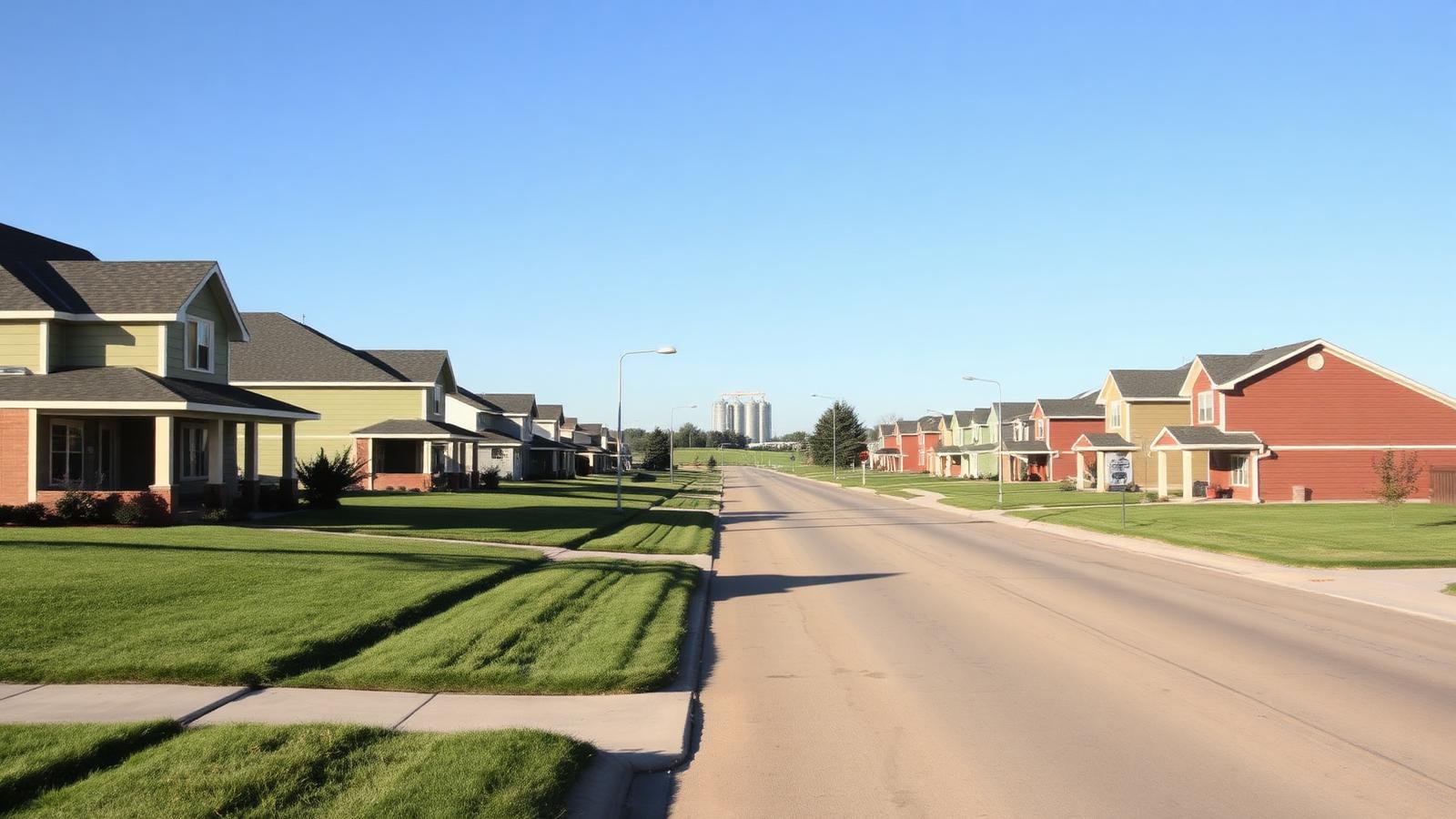
Kearney's housing stock includes an early twentieth-century core near downtown and the university, mid-century neighborhoods spreading north and south, and newer subdivisions on the city's edges built to serve steady, modest growth over the past two decades.
The ACS median home value for the city is $244,600, among the lowest of any full-service city featured on this site. Nebraska's property tax bills track assessed value closely, so even at these price points expect a real annual tax bill rather than a token one.
Inventory is broad relative to demand, and a California buyer with meaningful home equity can expect to purchase outright or with a very small mortgage in most Kearney neighborhoods.
Work and the local economy
The University of Nebraska at Kearney and CHI Health Good Samaritan, a regional referral hospital serving a large swath of central Nebraska, are the two largest employers and give the city an institutional stability unusual for its size.
Beyond those two, the economy runs on retail and distribution serving the surrounding agricultural region, food and manufacturing employers including several with a regional or national footprint, and the school district.
As with most Nebraska cities this size, the local job market rewards healthcare, education, and retail management skills far more than specialized white-collar fields, so remote or portable income substantially widens who this city works for.
Climate and setting
Kearney sits on the plains along the Platte River at a modest elevation, and shares Nebraska's continental climate: hot, sometimes humid summers with July highs commonly near 90, and cold winters with regular subfreezing days and periodic snow and ice.
Spring and early summer bring the state's most active severe weather, including thunderstorms and tornado risk, and wind is a near-constant feature of the open plains around the city.
The Platte River valley just south of town, part of the central flyway for sandhill cranes each spring, is a genuine local amenity and draws visitors from well beyond Nebraska during migration season.
Getting around, care, and schools
- Commercial air
- Kearney Regional Airport (EAR) has limited scheduled service; Omaha and Denver, each roughly two and a half hours by highway, are the practical airports for most trips.
- Highways
- Interstate 80 runs along the south side of the city, with US 30 and US 183 as principal arterials.
- Hospital
- CHI Health Good Samaritan, a regional referral hospital serving central Nebraska.
- Public schools
- Kearney Public Schools.
- Higher education
- University of Nebraska at Kearney.
- Setting
- Platte River valley on the Great Plains, roughly 2,140 feet elevation.
The trade-offs
- Air service is minimal; plan on a roughly two and a half hour drive to Omaha or Denver for most flights.
- The local job market outside healthcare, education, and retail is genuinely narrow.
- Cultural and dining variety reflect a city of about 34,000, not a metro.
- Wind and severe spring weather, including tornado risk, are routine features of life on the open plains here.
Other Nebraska towns people compare
Omaha
Nebraska's largest city and the deepest job market in the state, anchored by Berkshire Hathaway, Union Pacific, and a diversified Fortune 500 base.
Lincoln
Nebraska's capital and second-largest city, built around state government and the University of Nebraska, with a walkable core and consistently low unemployment.
Papillion
A southwest Omaha suburb in Sarpy County consistently cited among the best places to raise a family, with strong schools and a short commute into Omaha.
Elkhorn
A west Omaha growth corridor, formally annexed into the city of Omaha but retaining its own identity, ZIP code, and rapidly expanding schools.
Statewide figures, tax detail, and the full Nebraska picture are on the Nebraska page. Compare property, income, and sales tax across all 49 destination states on Taxes, and see where Californians are actually moving on Stats.
Sources
- US Census Bureau, American Community Survey 2020 to 2024 5-Year Estimates, table B25077 (median home value), retrieved via Census Reporter, September 3, 2026.
- US Census Bureau, ACS 2020 to 2024 5-Year Estimates, table B25103 (median real estate taxes paid, owner-occupied units with a mortgage), retrieved September 3, 2026.
- US Census Bureau, ACS 2020 to 2024 5-Year Estimates, table B25088 (median selected monthly owner costs, owner-occupied units with a mortgage), retrieved September 3, 2026.
- US Census Bureau, ACS 2020 to 2024 5-Year Estimates, table B01003 (total population), retrieved September 3, 2026.
- University of Nebraska at Kearney facts, unk.edu.
- CHI Health Good Samaritan facility information, chihealth.com.
See what your California equity buys in Kearney
Four short questions. We match you with one local agent and apply a closing cost credit funded from our referral fee.
Start your Kearney move
Four short questions. We use them to decide which agent fits your move, and to build your equity report.