
Ohio city guide
Moving From California to Powell, OH
A newer, fast-growing suburb north of Columbus for buyers who want recent construction rather than a century-old house.
Housing comparison
California versus Powell, side by side
- Median home value
- $725,800
- not available
- Median annual property tax
- $5,114
- not available
- Median monthly cost, owners with a mortgage
- $2,844
- not available
- Population
- 39.0 million (state)
- not available
Figures are US Census Bureau American Community Survey 2020 to 2024 5-Year Estimates for the city place. Property tax and monthly cost rows cover owner-occupied units with a mortgage, so they describe what current owners pay, not what a new buyer would pay at today's prices. California column is the statewide baseline used across this site.
Why Californians look at Powell
Powell is one of the newer suburbs in the Columbus ring, and most of its growth has happened since the 1990s, which means its housing stock skews far newer than Dublin's, Westerville's, or Cincinnati's. For a California buyer who does not want to inherit someone else's century-old plumbing and wiring, that is the entire pitch.
The city is small and largely residential, built around planned subdivisions, a compact historic Old Powell village core, and the Olentangy school district that draws many families to the area in the first place.
Powell shares the broader Columbus metro's economic base rather than having a large employment center of its own, so residents commute into Dublin, Polaris, or downtown Columbus for most jobs, trading a longer drive for newer construction and, generally, a quieter, more purely residential town.
Powell fits you if
- You want recently built homes with modern layouts, insulation, and systems rather than a century-old house.
- You are drawn to the Olentangy Local School District, one of the fastest-growing and highest-rated districts in the Columbus area.
- You want a quiet, primarily residential town and are comfortable commuting to Dublin or Columbus for work.
- You want a small-town main street (Old Powell) as an occasional amenity rather than your daily environment.
Look elsewhere if
- You want a historic or architecturally distinctive neighborhood; Powell's housing stock is almost entirely late twentieth and early twenty-first century.
- You want an in-town job market; Powell itself has limited local employment and most residents commute out.
- You want walkable urban density; Powell is a subdivision-based suburb outside its small historic core.
- You need a major-hub airport a short drive away rather than roughly 30 minutes.
Housing in Powell
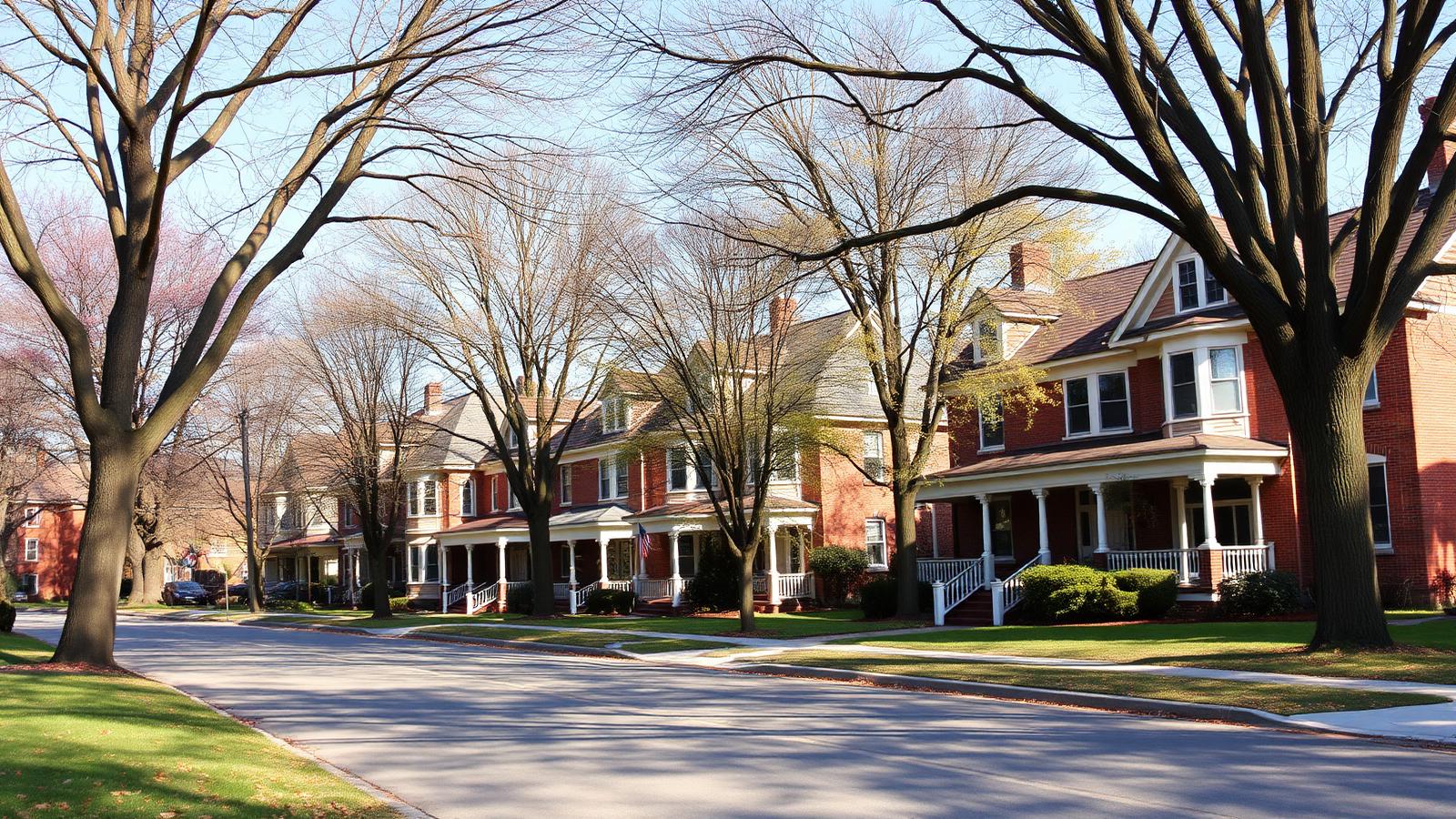
Powell's housing stock is overwhelmingly subdivision construction from the 1990s through the present, with larger lots and newer finishes than the older Columbus suburbs on this list. Old Powell, the small historic village core, holds a handful of older homes but is not representative of the broader housing market.
Because most homes are recently built, buyers should expect fewer of the deferred-maintenance surprises common in century-old housing stock, though that newer construction and the associated school district demand both carry a price premium within the Columbus metro.
Ohio property tax bills track current assessed value with no cap tied to purchase price, and Olentangy Local School District levies are a recurring feature of local ballots that residents should factor into long-run cost expectations.
Work and the local economy
Powell has limited employment of its own and functions primarily as a bedroom community within the Columbus metro. Most residents commute to nearby Dublin, the Polaris commercial corridor, or downtown Columbus.
That means the effective job market for a Powell household is the wider Columbus economy: insurance, retail and logistics headquarters, healthcare, higher education, and state government, rather than anything based in Powell itself.
Households relocating without remote income should plan their job search around the broader metro and treat Powell as a place to live rather than a place to work.
Climate and setting
Powell shares central Ohio's four-season continental climate: warm, humid summers with July highs typically in the mid-80s, cold winters with routine snow and January highs in the mid-30s, and an active spring severe weather season with occasional tornado watches.
As a newer, more open suburb with less mature tree cover than Westerville or Rocky River, some Powell subdivisions feel more exposed to summer sun and winter wind than older, tree-lined neighborhoods closer to the city.
As elsewhere in central Ohio, winter gray stretches for weeks between snow events, which is the most commonly cited adjustment for households arriving from California.
Getting around, care, and schools
- Commercial air
- John Glenn Columbus International Airport (CMH) is about 25 to 30 minutes away.
- Highways
- US 23 is the main north-south corridor connecting Powell to Columbus and Delaware.
- Hospital
- OhioHealth Dublin Methodist Hospital and Nationwide Children's Close To Home center are both nearby.
- Public schools
- Olentangy Local School District, one of the fastest-growing districts in Ohio.
- Higher education
- Ohio State's main campus and Otterbein University are both within a 20 to 30 minute drive.
- Setting
- Suburban, roughly 20 miles north of downtown Columbus.
The trade-offs
- Powell has little employment of its own, so nearly every household commutes out for work.
- The town is almost entirely residential and car-dependent outside the small Old Powell core.
- Newer construction and strong schools carry a real price premium within the Columbus metro.
- Specialty hospital care typically means a drive into Dublin or central Columbus.
Other Ohio towns people compare
Dublin
A Columbus suburb built around corporate headquarters and top-rated schools, with the highest home prices among Columbus-area suburbs but still a fraction of California's.
Cincinnati
A major Ohio River city with a deep corporate employment base, distinctive nineteenth century neighborhoods, and the lowest big-city housing costs on this list.
Westerville
A walkable historic downtown north of Columbus that draws relocating families for its schools and its Uptown district, at prices below Dublin's.
Rocky River
A lakefront Cleveland suburb with mature housing stock, a short commute into downtown, and Lake Erie at its doorstep.
Statewide figures, tax detail, and the full Ohio picture are on the Ohio page. Compare property, income, and sales tax across all 49 destination states on Taxes, and see where Californians are actually moving on Stats.
Sources
- US Census Bureau, American Community Survey 2020 to 2024 5-Year Estimates, table B25077 (median home value), retrieved via Census Reporter, September 3, 2026.
- US Census Bureau, ACS 2020 to 2024 5-Year Estimates, table B25103 (median real estate taxes paid, owner-occupied units with a mortgage), retrieved September 3, 2026.
- US Census Bureau, ACS 2020 to 2024 5-Year Estimates, table B25088 (median selected monthly owner costs, owner-occupied units with a mortgage), retrieved September 3, 2026.
- US Census Bureau, ACS 2020 to 2024 5-Year Estimates, table B01003 (total population), retrieved September 3, 2026.
- Olentangy Local School District, olentangy.k12.oh.us.
- City of Powell, Ohio, cityofpowell.us.
See what your California equity buys in Powell
Four short questions. We match you with one local agent and apply a closing cost credit funded from our referral fee.
Start your Powell move
Four short questions. We use them to decide which agent fits your move, and to build your equity report.