
Arizona city guide
Moving From California to Tucson, AZ
Arizona's second-largest city, cheaper than Phoenix and several degrees cooler in summer, anchored by the University of Arizona and a defense and aerospace employment base.
Housing comparison
California versus Tucson, side by side
- Median home value
- $725,800
- $266,200
- Median annual property tax
- $5,114
- $1,849
- Median monthly cost, owners with a mortgage
- $2,844
- $1,482
- Population
- 39.0 million (state)
- 547,073
Figures are US Census Bureau American Community Survey 2020 to 2024 5-Year Estimates for the city place. Property tax and monthly cost rows cover owner-occupied units with a mortgage, so they describe what current owners pay, not what a new buyer would pay at today's prices. California column is the statewide baseline used across this site.
Why Californians look at Tucson
Tucson is Arizona's second-largest city and its own metro, about 115 miles southeast of Phoenix, closer to the Mexican border than to the Valley's job market. It has its own economy, its own university, and its own identity, and should not be treated as a cheaper Phoenix suburb.
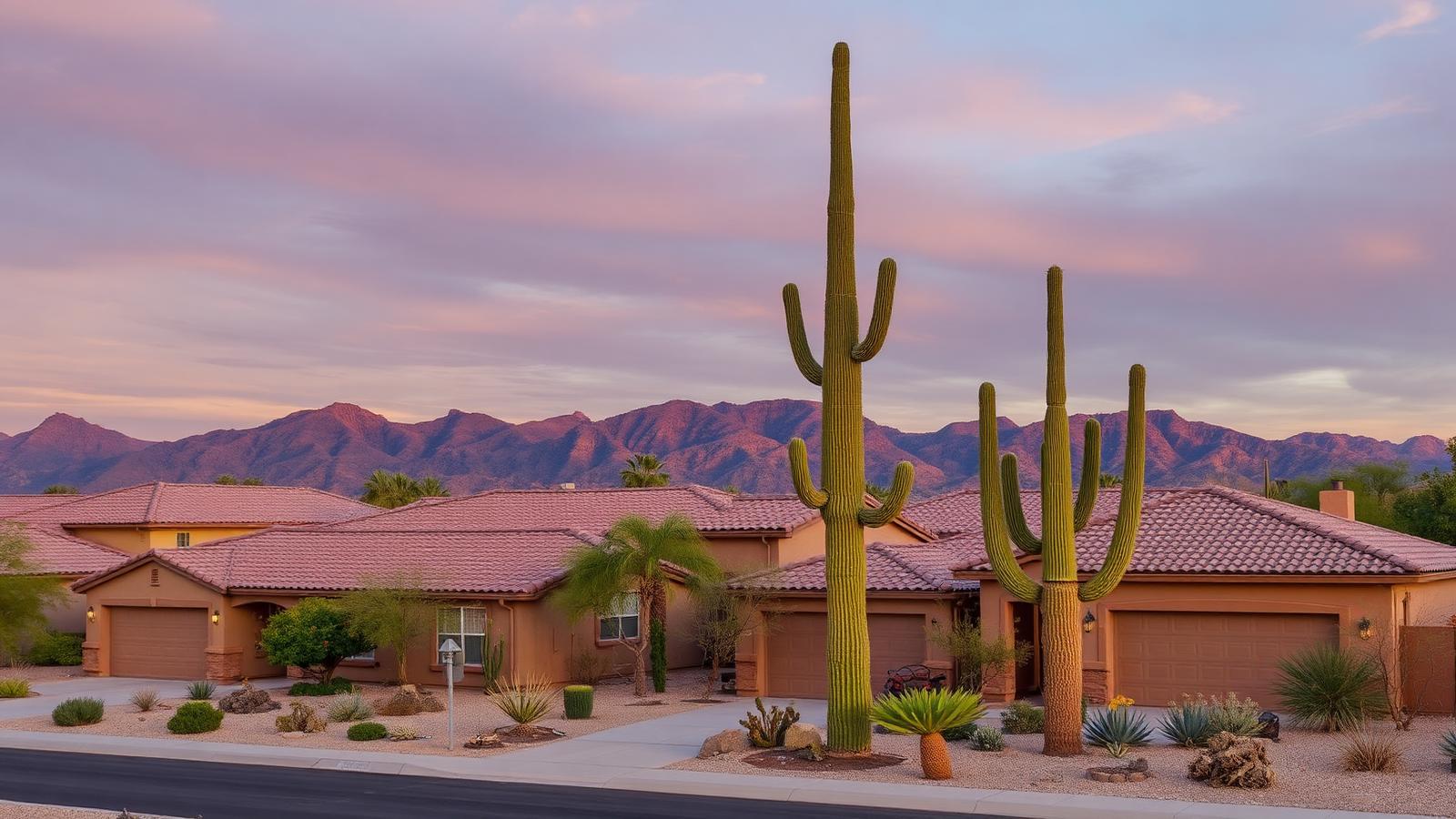
The University of Arizona anchors the city both economically and culturally, and Tucson's desert setting, ringed by mountain ranges including the Santa Catalinas, gives it a more dramatic landscape than the flatter Phoenix basin, along with a summer that runs a few degrees cooler on average.
For a California seller, Tucson offers the lowest home prices of any city in this guide by a wide margin, alongside a broader mix of university, defense, and healthcare employment than a typical bedroom suburb.
Tucson fits you if
- You want the lowest home prices among Arizona's larger cities, with a real local economy rather than a bedroom-suburb one.
- You value a university town's culture, including sports, arts, and academic medicine.
- You want work in aerospace, defense, or optics; Raytheon (RTX) and Davis-Monthan Air Force Base are major local employers.
- You want slightly cooler summer nights than Phoenix and a more dramatic desert-mountain landscape.
Look elsewhere if
- You want proximity to Phoenix Sky Harbor or the Phoenix job market; Tucson is a separate metro, not a suburb.
- You want the newest housing stock. Much of Tucson's stock is older than Phoenix's rapidly built suburbs.
- You need a large corporate or finance employment base; Tucson's private sector is smaller and more concentrated than metro Phoenix's.
- You expect low crime and poverty statistics matching the wealthier Phoenix suburbs; Tucson's citywide poverty rate runs notably higher.
Housing in Tucson
Tucson's housing stock includes historic adobe and territorial-style homes near downtown and the university, mid-century ranch neighborhoods spreading east and north, and newer subdivisions toward the outskirts, including the Northwest side toward Marana and Oro Valley.
The ACS median home value for the city is $266,200, roughly half of Phoenix-area suburbs like Gilbert or Peoria and far below Scottsdale. The median annual property tax bill for owners with a mortgage is $1,849, and the median monthly owner cost with a mortgage is $1,482, the lowest monthly figure of any city in this guide.
That affordability comes with a wider range of neighborhood quality and older infrastructure in some areas than newer Valley suburbs, so buyers should look closely at a specific block rather than assume citywide averages apply everywhere.
Work and the local economy
The University of Arizona is the city's largest employer by a wide margin, driving both direct university jobs and the academic medical center, Banner University Medical Center Tucson, that grew out of it.
Raytheon (RTX) operates a major missile systems facility in Tucson, and Davis-Monthan Air Force Base, home of the 355th Wing and the aircraft boneyard, is a significant employer and economic anchor as well. Together, defense and aerospace form one of the city's steadiest sectors.
Healthcare, tourism tied to the winter resort season and Sonoran Desert scenery, and a modest but growing tech sector round out the base. Median household income runs below the Phoenix metro and the citywide poverty rate is higher, a factor to weigh against the lower home prices.
Climate and setting
Tucson sits at roughly 2,400 feet, somewhat higher than Phoenix, and its summer highs run a few degrees cooler on average, though it is still a genuinely hot desert summer with many days above 100 degrees in June through August.
Winters are mild and dry, with daytime highs typically in the 60s and 70s, and the surrounding mountain ranges, including the Santa Catalinas north of the city, hold snow that is visible from the valley floor without falling in town.
Monsoon season, roughly July through September, brings dramatic afternoon thunderstorms and occasional flash flooding in washes, a seasonal rhythm distinct from anything in coastal California.
Getting around, care, and schools
- Commercial air
- Tucson International Airport (TUS) offers direct service to major western hubs; Phoenix Sky Harbor, about 115 miles north, has broader international service.
- Highways
- Interstate 10 runs through the city; Interstate 19 connects south toward Nogales and the border.
- Hospital
- Banner University Medical Center Tucson and TMC HealthCare are the city's major hospital systems.
- Public schools
- Tucson Unified School District, along with several smaller districts covering suburban areas.
- Higher education
- The University of Arizona, a major public research university, is based in the city.
- Setting
- Sonoran Desert basin ringed by mountain ranges, roughly 2,400 feet elevation.
The trade-offs
- Tucson is a separate metro from Phoenix, not a suburb of it. Do not plan on a Phoenix commute.
- Citywide poverty and income figures run less favorable than the wealthier Phoenix suburbs in this guide.
- Summer heat is still severe, even if a few degrees milder than Phoenix on average.
- Housing stock and neighborhood quality vary more block to block than in newer, more uniform Valley suburbs.
Other Arizona towns people compare
Gilbert
The East Valley's default family suburb, with top-rated public schools, low crime, and master-planned subdivisions built over the last three decades.
Scottsdale
The Valley's luxury market and resort town, stretching from walkable Old Town to golf communities in the north, with the region's deepest high-end housing inventory.
Peoria
West Valley value with Lake Pleasant recreation, spring training baseball, and a shorter run to Interstate 10 for the drive back to California.
Prescott
A mile-high mountain town 90 miles north of Phoenix, with four mild seasons, Ponderosa pine forest, and a retiree-heavy population that avoids the low-desert heat.
Queen Creek
The fastest-growing town in the Southeast Valley, with the largest concentration of new-construction incentives in metro Phoenix and a school system still building to keep pace.
Statewide figures, tax detail, and the full Arizona picture are on the Arizona page. Compare property, income, and sales tax across all 49 destination states on Taxes, and see where Californians are actually moving on Stats.
Sources
- US Census Bureau, American Community Survey 2020 to 2024 5-Year Estimates, table B25077 (median home value), retrieved via Census Reporter, September 3, 2026.
- US Census Bureau, ACS 2020 to 2024 5-Year Estimates, table B25103 (median real estate taxes paid, owner-occupied units with a mortgage), retrieved September 3, 2026.
- US Census Bureau, ACS 2020 to 2024 5-Year Estimates, table B25088 (median selected monthly owner costs, owner-occupied units with a mortgage), retrieved September 3, 2026.
- US Census Bureau, ACS 2020 to 2024 5-Year Estimates, table B01003 (total population), retrieved September 3, 2026.
- Arizona Commerce Authority community profile for Tucson, azcommerce.com.
- University of Arizona Tech Parks, Tucson economic outlook coverage, techparks.arizona.edu.
See what your California equity buys in Tucson
Four short questions. We match you with one local agent and apply a closing cost credit funded from our referral fee.
Start your Tucson move
Four short questions. We use them to decide which agent fits your move, and to build your equity report.