
Texas city guide
Moving From California to Austin, TX
The closest cultural fit for Bay Area transplants in Texas, and the priciest Texas market, built on a tech and university economy.
Housing comparison
California versus Austin, side by side
- Median home value
- $725,800
- $555,300
- Median annual property tax
- $5,114
- $8,436
- Median monthly cost, owners with a mortgage
- $2,844
- $2,679
- Population
- 39.0 million (state)
- 979,539
Figures are US Census Bureau American Community Survey 2020 to 2024 5-Year Estimates for the city place. Property tax and monthly cost rows cover owner-occupied units with a mortgage, so they describe what current owners pay, not what a new buyer would pay at today's prices. California column is the statewide baseline used across this site.
Why Californians look at Austin
Austin is the Texas city that draws the most direct comparisons to California, for good reason. It combines a large public university, a genuine live music and food culture, a growing tech sector anchored by major employers who have opened campuses here, and a politically liberal city surrounded by a much more conservative state, a dynamic familiar to many Bay Area transplants.
It is also, by a wide margin, the most expensive city in Texas. The ACS median home value of $555,300 is nearly double Houston's and well above Dallas or Fort Worth, though it remains meaningfully below most California coastal markets.
Austin's growth over the last decade, driven heavily by tech relocations and remote workers, has strained roads, schools, and housing supply faster than the city has been able to build. A relocating household should expect traffic and construction to be constants rather than temporary conditions.
Austin fits you if
- You work in tech and want to stay connected to a major tech labor market while leaving California's cost structure behind.
- You want live music, a food scene, and a college-town cultural energy in a Texas setting.
- You are comfortable paying the highest home prices in Texas in exchange for the closest lifestyle match to parts of California.
- You want access to the Texas Hill Country for weekend recreation without leaving the metro.
Look elsewhere if
- You are relocating specifically to escape high home prices. Austin is the priciest city in this guide and the gap with cheaper Texas metros is significant.
- You dislike traffic and ongoing construction. Austin's infrastructure has lagged its population growth for years.
- You want political and cultural conformity with the rest of the state. Austin is a liberal city inside a conservative state, and that mismatch shapes local politics and school board fights.
- You need a diversified economy. Austin is more tied to tech than any other Texas metro, and a tech downturn hits harder here.
Housing in Austin
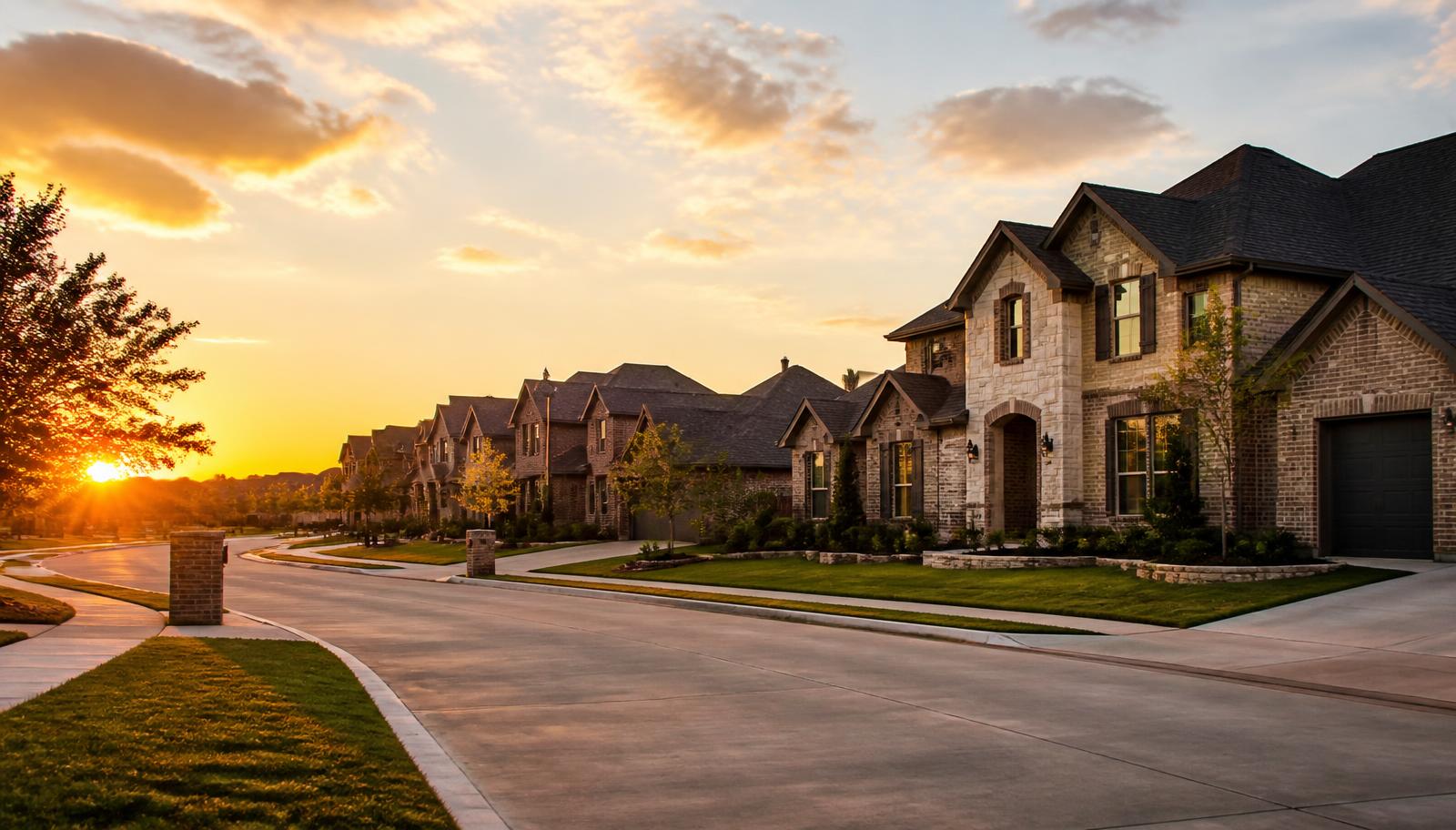
Austin's housing stock ranges from converted homes and dense new mid-rise development near downtown and South Congress, to 1970s and 1980s ranch neighborhoods farther out, to fast-growing new subdivisions in suburbs like Round Rock, Cedar Park, and Pflugerville. The ACS median home value for the city is $555,300, and the median annual property tax for mortgaged owners is $8,436, the highest tax bill of the Texas cities in this guide.
The median monthly owner cost with a mortgage is $2,679. Prices rose sharply during the pandemic-era tech relocation wave and have cooled somewhat since, but Austin remains priced well above every other major Texas city.
Buyers priced out of the city proper commonly look to Round Rock, Georgetown, or Leander to the north, or to Kyle and Buda to the south, trading a longer commute for a meaningfully lower price.
Work and the local economy
Technology is the defining sector, with a mix of large employer campuses, a dense startup scene, and a steady stream of relocating tech workers over the past decade. The University of Texas at Austin, the state's flagship research university, supplies both talent and research spinoffs that feed the tech and biotech sectors.
State government is also a significant employer, since Austin is the Texas capital, which provides a stabilizing counterweight to the tech sector's cyclicality.
The narrowness of the economy is the honest risk. A downturn concentrated in tech hits Austin's job market and housing demand harder than it hits the more diversified economies of Dallas or Houston.
Climate and setting
Austin sits at the edge of the Texas Hill Country, with a humid subtropical climate that runs hotter and drier than Houston. Summers are long and hot, regularly reaching the upper 90s and above from June through September, and the surrounding Hill Country provides more topographic variety than Houston or Dallas.
Winters are short and mild, though occasional severe winter storms, including the 2021 statewide grid failure, have shown that Texas's power grid can strain badly during rare cold snaps.
Drought and wildfire risk in the surrounding Hill Country are real seasonal concerns, along with periodic flash flooding along the region's creeks during intense summer storms.
Getting around, care, and schools
- Commercial air
- Austin-Bergstrom International Airport (AUS), about five miles southeast of downtown, with a growing list of domestic and some international nonstop routes.
- Highways
- Interstate 35 runs through the center of the metro; State Highway 130 and MoPac (Loop 1) are the main relief routes.
- Hospital
- Dell Seton Medical Center at the University of Texas, the teaching hospital for the Dell Medical School.
- Public schools
- Austin Independent School District covers the city; suburban districts such as Round Rock and Leander ISD serve much of the surrounding growth.
- Higher education
- The University of Texas at Austin, a major public research university.
- Setting
- Rolling terrain at the eastern edge of the Texas Hill Country, generally 400 to 900 feet in elevation.
The trade-offs
- Home prices are the highest of any Texas city in this guide, closing much of the gap with cheaper parts of California.
- Traffic and construction have outpaced infrastructure growth for years, and Interstate 35 through downtown is a persistent bottleneck.
- The economy leans heavily on tech, which means it also carries tech's downturn risk more than other Texas metros.
- Summer heat is intense and prolonged, and drought years bring real water restrictions and wildfire concern in the surrounding hills.
Other Texas towns people compare
Dallas–Fort Worth
Texas's deepest job market and its broadest range of price points, spread across two cities and dozens of suburbs, tied together by DFW International Airport.
Houston
The largest inventory and the lowest price per square foot among the big four Texas metros, built around energy, the Port of Houston, and the Texas Medical Center.
San Antonio
The lowest overall cost of living among the big Texas metros, with steady appreciation and one of the largest military communities in the country.
Fort Worth
More house per dollar than Dallas proper, with the same regional job access and a stronger claim to a genuine historic downtown.
The Woodlands
A master-planned suburb north of Houston, popular with relocating families for its schools, greenbelts, and corporate employers along Interstate 45.
Statewide figures, tax detail, and the full Texas picture are on the Texas page. Compare property, income, and sales tax across all 49 destination states on Taxes, and see where Californians are actually moving on Stats.
Sources
- US Census Bureau, American Community Survey 2020 to 2024 5-Year Estimates, table B25077 (median home value), retrieved via Census Reporter, September 3, 2026.
- US Census Bureau, ACS 2020 to 2024 5-Year Estimates, table B25103 (median real estate taxes paid, owner-occupied units with a mortgage), retrieved September 3, 2026.
- US Census Bureau, ACS 2020 to 2024 5-Year Estimates, table B25088 (median selected monthly owner costs, owner-occupied units with a mortgage), retrieved September 3, 2026.
- US Census Bureau, ACS 2020 to 2024 5-Year Estimates, table B01003 (total population), retrieved September 3, 2026.
- Austin-Bergstrom International Airport, austintexas.gov/austin-bergstrom-international-airport.
- Ascension Seton, healthcare.ascension.org.
- University of Texas at Austin, utexas.edu.
See what your California equity buys in Austin
Four short questions. We match you with one local agent and apply a closing cost credit funded from our referral fee.
Start your Austin move
Four short questions. We use them to decide which agent fits your move, and to build your equity report.