
Texas city guide
Moving From California to Dallas–Fort Worth, TX
Texas's deepest job market and its broadest range of price points, spread across two cities and dozens of suburbs, tied together by DFW International Airport.
Housing comparison
California versus Dallas–Fort Worth, side by side
- Median home value
- $725,800
- $320,700
- Median annual property tax
- $5,114
- $6,533
- Median monthly cost, owners with a mortgage
- $2,844
- $2,316
- Population
- 39.0 million (state)
- 1,307,930
Figures are US Census Bureau American Community Survey 2020 to 2024 5-Year Estimates for the city place. Property tax and monthly cost rows cover owner-occupied units with a mortgage, so they describe what current owners pay, not what a new buyer would pay at today's prices. California column is the statewide baseline used across this site.
Why Californians look at Dallas–Fort Worth
Dallas–Fort Worth is not one city, it is a metro of more than a hundred municipalities stretched across North Texas, anchored by Dallas on the east side and Fort Worth on the west, with Arlington, Plano, Frisco, McKinney, and dozens of other suburbs filling in between. For a relocating household the practical question is rarely 'Dallas or Fort Worth,' it is which suburb fits the job, the school district, and the budget.
The figures below describe the city of Dallas itself, the principal city used for ACS place-level data. Fort Worth is covered separately in this guide because its housing costs and character differ enough to matter, and most families moving to the metro end up in a suburb of one or the other rather than in either downtown.
The pull of DFW is the job market. It is the deepest and most diversified in Texas, with corporate headquarters across finance, telecom, defense, and logistics, and it does not lean on a single industry the way Houston leans on energy or Austin leans on tech.
Dallas–Fort Worth fits you if
- You want the widest range of employers and the most corporate headquarters of any Texas metro.
- You want suburban school districts with strong reputations and are willing to commute for them.
- You are relocating a family and want variety: urban, suburban, and exurban options within one job market.
- You need a major international airport with extensive nonstop service, including to California.
Look elsewhere if
- You want a single, compact, walkable city. DFW is a sprawling, car-dependent metro with no true center.
- You dislike long commutes. Traffic on the LBJ Freeway, I-35E, and I-30 corridors is a daily fact of life.
- You want mild, dry weather. North Texas summers are hot and humid, and severe thunderstorms and tornadoes are a real seasonal risk.
- You need walkable transit. DART rail is useful in parts of Dallas but most of the metro requires a car.
Housing in Dallas–Fort Worth
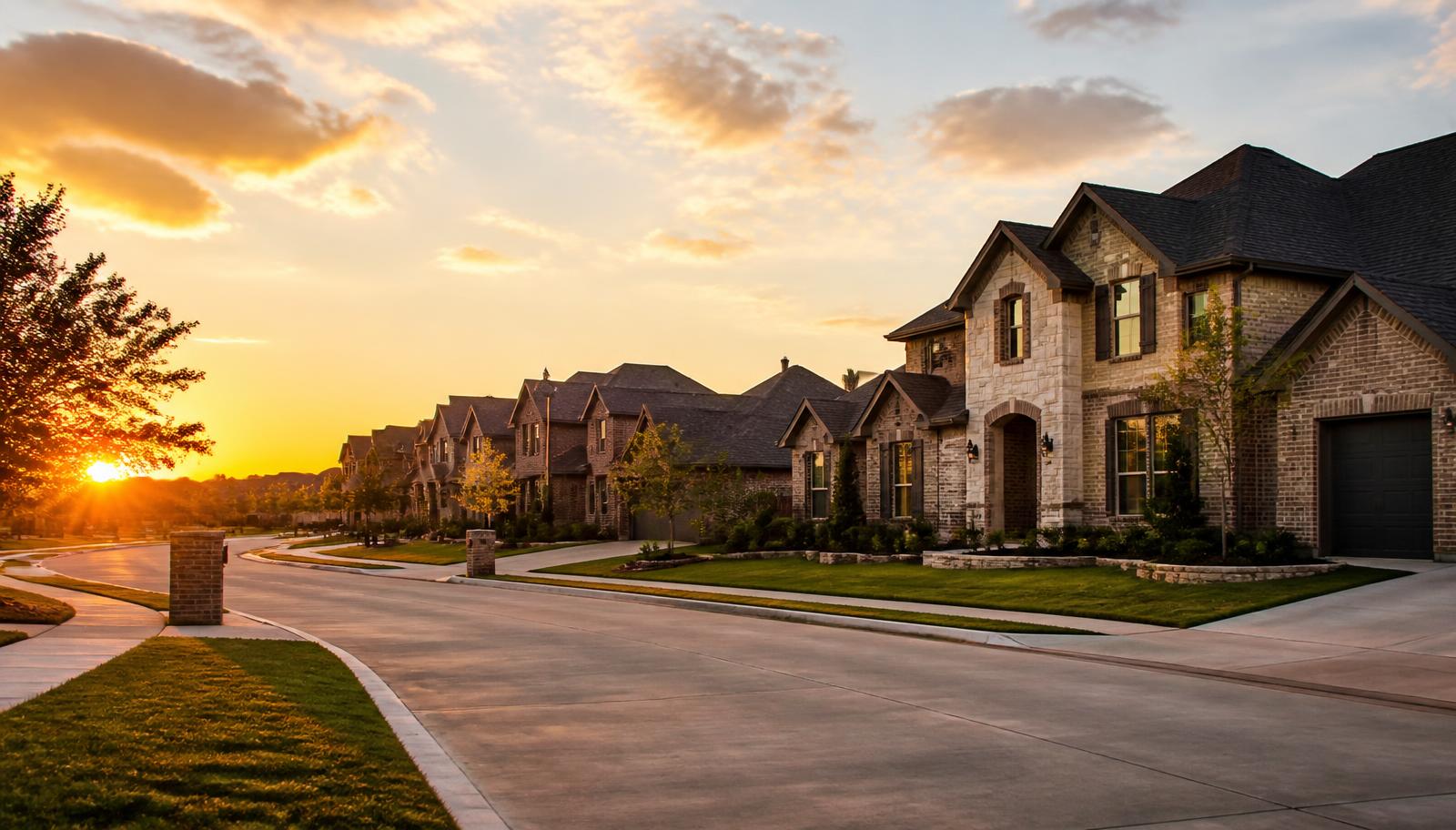
The city of Dallas itself contains everything from converted lofts downtown to 1950s ranch neighborhoods in Oak Cliff and East Dallas to new construction on the far north edge. The ACS median home value for the city of Dallas is $320,700, and the median annual real estate tax for owners with a mortgage is $6,533, a figure that reflects Texas's reliance on property tax in place of a state income tax.
The median monthly owner cost for mortgaged homes in Dallas is $2,316. Suburban districts such as Plano, Frisco, and Southlake carry higher prices and higher tax bills tied to strong school ratings, while suburbs farther out, such as parts of Mesquite or Grand Prairie, run below the city figure.
Because the metro is so large, the honest approach for a relocating buyer is to pick the job location and the school district first, then compare property tax rates city by city, since Texas school and municipal tax rates vary by jurisdiction even within the same metro.
Work and the local economy
DFW hosts a large concentration of corporate headquarters across banking, telecommunications, defense, insurance, and logistics, supported by American Airlines' hub operations at DFW International Airport. The job base is broader than any other Texas metro, which is the main reason households relocate here for work rather than for climate or lifestyle.
Healthcare and education are also major employers, with UT Southwestern Medical Center and the hospital systems built around it forming one of the largest medical employment clusters in the state.
The tradeoff for that breadth is a long commute culture. Many well-paid jobs sit in office parks along the Dallas North Tollway or in Las Colinas, and workers often live thirty to forty-five minutes away by design, trading commute time for a newer house and a preferred school district.
Climate in North Texas
Dallas–Fort Worth has a humid subtropical climate with hot summers, generally averaging highs in the mid-90s in July and August, and mild but genuinely cold winters that occasionally bring ice storms capable of shutting the metro down for days.
Spring is severe weather season. North Texas sits in a corridor prone to large hail and tornadoes, and homeowners insurance premiums reflect that risk, along with the state's broader trend of rising insurance costs.
Humidity is the biggest adjustment for Californians. Summer nights rarely cool off the way they do in most of California, and outdoor activity in July and August is generally an early-morning or evening affair.
Getting around, care, and schools
- Commercial air
- Dallas Fort Worth International Airport (DFW), a major American Airlines hub with extensive domestic and international nonstop service, plus Dallas Love Field for close-in domestic flights.
- Highways
- Interstates 35E, 30, 20, and 45 converge in the metro, along with the President George Bush and Sam Rayburn tollways.
- Hospital
- Parkland Memorial Hospital and UT Southwestern Medical Center form the region's major public teaching hospital complex.
- Public schools
- Dallas Independent School District covers the city; most relocating families choose a suburban district such as Plano, Frisco, or Highland Park instead.
- Higher education
- Southern Methodist University, the University of Texas at Dallas, and the University of Texas at Arlington.
- Setting
- Flat to gently rolling North Texas prairie, no significant elevation change across the metro.
The trade-offs
- The metro has no single center. Expect to define your life around a suburb and a highway corridor, not around 'Dallas' as a whole.
- Property tax bills are a real ongoing cost. Texas has no state income tax, but school and municipal tax rates make property tax bills higher here than the Texas cities with smaller populations.
- Severe spring weather, including hail and tornadoes, is a standing risk that shows up in insurance premiums.
- Traffic is a daily variable. Commute planning should assume rush-hour delay on the major freeways, not free-flowing traffic.
Other Texas towns people compare
Houston
The largest inventory and the lowest price per square foot among the big four Texas metros, built around energy, the Port of Houston, and the Texas Medical Center.
Austin
The closest cultural fit for Bay Area transplants in Texas, and the priciest Texas market, built on a tech and university economy.
San Antonio
The lowest overall cost of living among the big Texas metros, with steady appreciation and one of the largest military communities in the country.
Fort Worth
More house per dollar than Dallas proper, with the same regional job access and a stronger claim to a genuine historic downtown.
The Woodlands
A master-planned suburb north of Houston, popular with relocating families for its schools, greenbelts, and corporate employers along Interstate 45.
Statewide figures, tax detail, and the full Texas picture are on the Texas page. Compare property, income, and sales tax across all 49 destination states on Taxes, and see where Californians are actually moving on Stats.
Sources
- US Census Bureau, American Community Survey 2020 to 2024 5-Year Estimates, table B25077 (median home value), retrieved via Census Reporter, September 3, 2026.
- US Census Bureau, ACS 2020 to 2024 5-Year Estimates, table B25103 (median real estate taxes paid, owner-occupied units with a mortgage), retrieved September 3, 2026.
- US Census Bureau, ACS 2020 to 2024 5-Year Estimates, table B25088 (median selected monthly owner costs, owner-occupied units with a mortgage), retrieved September 3, 2026.
- US Census Bureau, ACS 2020 to 2024 5-Year Estimates, table B01003 (total population), retrieved September 3, 2026.
- Dallas Fort Worth International Airport, dfwairport.com.
- Parkland Health, parklandhealth.org.
- UT Southwestern Medical Center, utswmed.org.
See what your California equity buys in Dallas–Fort Worth
Four short questions. We match you with one local agent and apply a closing cost credit funded from our referral fee.
Start your Dallas–Fort Worth move
Four short questions. We use them to decide which agent fits your move, and to build your equity report.