
North Dakota city guide
Moving From California to Fargo, ND
North Dakota's largest city and its tech and healthcare center, with the broadest housing supply and job market in the state.
Housing comparison
California versus Fargo, side by side
- Median home value
- $725,800
- $281,900
- Median annual property tax
- $5,114
- not available
- Median monthly cost, owners with a mortgage
- $2,844
- not available
- Population
- 39.0 million (state)
- 138,059
Figures are US Census Bureau American Community Survey 2020 to 2024 5-Year Estimates for the city place. Property tax and monthly cost rows cover owner-occupied units with a mortgage, so they describe what current owners pay, not what a new buyer would pay at today's prices. California column is the statewide baseline used across this site.
Why Californians look at Fargo
Fargo is the obvious landing spot for a California household that wants a real city rather than a small town, while still buying at North Dakota prices. It sits on the Red River across from Moorhead, Minnesota, and functions as the retail, medical, and higher-education hub for a wide stretch of the northern Plains.
The local economy is unusually diversified for a city this size. Fargo has a genuine technology sector built around companies like Microsoft's local campus and homegrown software firms, alongside two large hospital systems and North Dakota State University. That mix means job options exist beyond government and agriculture, which is not true of most of the state.
For a seller leaving California, the math is simple. A typical Fargo home costs a fraction of the California median, North Dakota has no requirement to prove the winters won't matter to you, and there is no substitute for visiting in January before you commit.
Fargo fits you if
- You want the largest job market and widest housing selection in North Dakota, including tech and healthcare roles.
- You are buying with California equity and want a paid-off or near paid-off house with room to spare.
- You want a real airport, a university, and two hospital systems in the same town.
- You do not mind a genuinely cold, long winter in exchange for low cost and low density stress.
Look elsewhere if
- You need mild winters. Fargo's winters are long, cold, and can include serious wind chill and occasional ice.
- You want mountains, ocean, or dramatic terrain nearby. The landscape here is flat prairie in every direction.
- You need year-round direct flights to many destinations. Hector International has a limited route map.
- You want a large, dense metro with extensive nightlife and cultural institutions.
Housing in Fargo
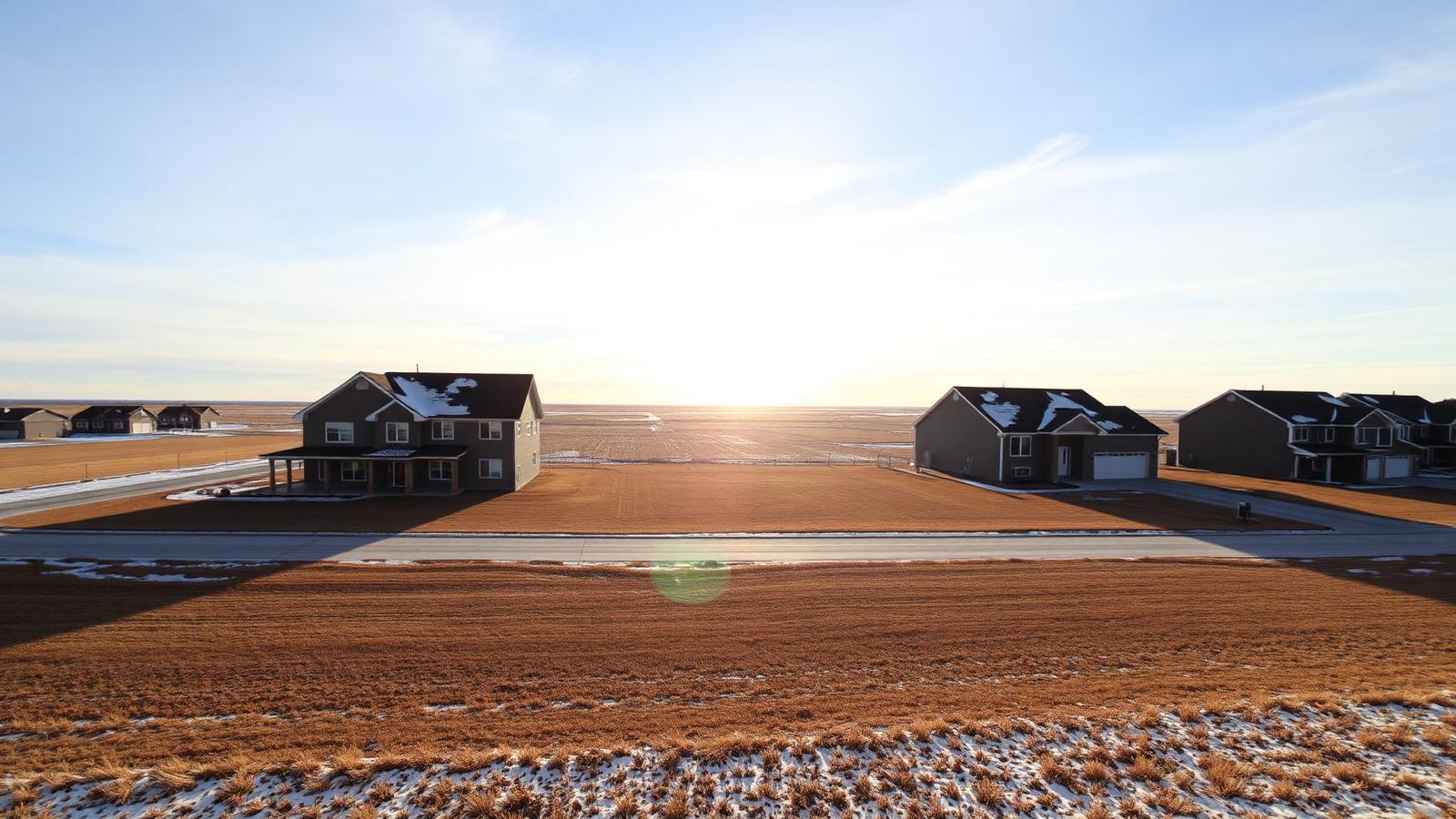
Fargo's housing ranges from older post-war neighborhoods near downtown and NDSU to large newer subdivisions on the south and west edges of town, plus a growing number of apartments and townhomes aimed at young professionals working downtown or at the tech employers.
The ACS median home value for the city is $281,900. Property tax and owner-cost figures specific to Fargo were not confidently sourced for this page and are omitted rather than estimated; North Dakota has no state income tax exemption comparable to some neighboring states, so buyers should check current mill levies with Cass County directly.
Because Fargo is the regional hub, competition from smaller surrounding towns pushes some buyers toward West Fargo or Moorhead for newer construction at a similar or lower price. Inventory in Fargo proper turns at a normal, unhurried pace compared with California markets.
Work and the local economy
Healthcare is the largest employment sector, anchored by Sanford Health and Essentia Health, both of which run large hospital and clinic systems headquartered or heavily staffed in Fargo. North Dakota State University adds a stable base of faculty, staff, and research jobs.
Technology and financial services have grown steadily, with a significant Microsoft campus tracing back to the acquisition of local software firm Great Plains Software, plus a cluster of smaller software and fintech companies that have grown up around it.
Agriculture and agribusiness remain important to the regional economy even though farming itself happens outside city limits, since Fargo is the banking, equipment, and grain-trade center for a large agricultural hinterland.
Climate and setting
Fargo sits on flat prairie at a modest elevation with no natural windbreaks, which makes both summer heat and winter cold feel more intense. Winters are long, typically running from November into March, with subzero mornings common in January.
Summers are warm and can be humid, with thunderstorms and occasional severe weather including tornado risk in the spring and early summer. The growing season is short but reliable.
The Red River is prone to spring flooding in wet years, and the city and surrounding communities have invested heavily in diversion and levee projects. It is worth asking any specific neighborhood's flood history before buying.
Getting around, care, and schools
- Commercial air
- Hector International Airport (FAR) offers direct flights to major hubs including Minneapolis, Denver, and Chicago.
- Highways
- Interstate 94 east to west and Interstate 29 north to south cross near the city.
- Hospital
- Sanford Medical Center Fargo and Essentia Health Fargo, both large regional referral hospitals.
- Public schools
- Fargo Public Schools.
- Higher education
- North Dakota State University and Minnesota State Community and Technical College.
- Setting
- Flat prairie along the Red River, elevation about 900 feet.
The trade-offs
- Winters are a real commitment, not a mild inconvenience. Plan for regular subzero stretches.
- The landscape is flat prairie with no mountains, ocean, or major topography nearby.
- Air service, while the best in the state, is still limited compared with a major California airport.
- Spring flood risk along the Red River is a genuine factor in some neighborhoods and should be checked property by property.
Other North Dakota towns people compare
Bismarck
The state capital, with stable government employment and slightly milder winters than Fargo and Grand Forks to the east.
West Fargo
The Fargo metro's fastest-growing suburb, with newer housing stock and strong schools, at a short commute from downtown Fargo.
Grand Forks
A university and air base town in the Red River Valley, with low prices and a steady rental market.
Minot
The hub of the energy and military economy in northwest North Dakota, with the lowest entry prices of the state's larger cities.
Statewide figures, tax detail, and the full North Dakota picture are on the North Dakota page. Compare property, income, and sales tax across all 49 destination states on Taxes, and see where Californians are actually moving on Stats.
Sources
- US Census Bureau, American Community Survey 2020 to 2024 5-Year Estimates, table B25077 (median home value), retrieved via Census Reporter, September 3, 2026.
- US Census Bureau, ACS 2020 to 2024 5-Year Estimates, table B25103 (median real estate taxes paid, owner-occupied units with a mortgage), retrieved September 3, 2026.
- US Census Bureau, ACS 2020 to 2024 5-Year Estimates, table B25088 (median selected monthly owner costs, owner-occupied units with a mortgage), retrieved September 3, 2026.
- US Census Bureau, ACS 2020 to 2024 5-Year Estimates, table B01003 (total population), retrieved September 3, 2026.
- Census Reporter, Fargo, ND profile data, censusreporter.org.
- GeoStat.org, Home Values in Fargo, North Dakota, geostat.org.
- Hector International Airport route information, fargond.gov/airport.
See what your California equity buys in Fargo
Four short questions. We match you with one local agent and apply a closing cost credit funded from our referral fee.
Start your Fargo move
Four short questions. We use them to decide which agent fits your move, and to build your equity report.