
Kansas city guide
Moving From California to Manhattan, KS
Home to Kansas State University and next door to Fort Riley, giving the city an unusually stable rental and resale market for its size.
Housing comparison
California versus Manhattan, side by side
- Median home value
- $725,800
- not available
- Median annual property tax
- $5,114
- not available
- Median monthly cost, owners with a mortgage
- $2,844
- not available
- Population
- 39.0 million (state)
- 54,239
Figures are US Census Bureau American Community Survey 2020 to 2024 5-Year Estimates for the city place. Property tax and monthly cost rows cover owner-occupied units with a mortgage, so they describe what current owners pay, not what a new buyer would pay at today's prices. California column is the statewide baseline used across this site.
Why Californians look at Manhattan
Manhattan, known locally as the Little Apple, sits in the Flint Hills of northeast Kansas along the Kansas River. It is a university town built around Kansas State University, and its housing and rental market benefits from a second, less obvious anchor: Fort Riley, a major US Army post about 15 minutes west, whose soldiers and families cycle through the local rental market on a predictable schedule.
That combination, a large public university plus a major Army installation, gives Manhattan a rental and resale market that behaves more steadily than a typical small Midwestern city, because demand does not depend on a single private employer's fortunes.
For a California household, Manhattan offers a genuine college-town feel, Flint Hills scenery unlike the flatter parts of the state, and prices well below Kansas City metro suburbs, with the trade-off of a smaller and more specialized local economy.
Manhattan fits you if
- You want a college-town environment with Kansas State athletics, arts, and campus life nearby.
- You are connected to Fort Riley through military service, retirement, or civilian Army employment.
- You want lower prices than the Kansas City suburbs with a still-active rental market if you plan to invest.
- You appreciate the rolling Flint Hills landscape rather than flat prairie.
Look elsewhere if
- You need a broad private-sector job market outside of the university, the Army post, and healthcare.
- You want proximity to a major metro airport. Manhattan is roughly two hours from Kansas City.
- You want to avoid the seasonal rhythms of a university and military town, including turnover around PCS season and the academic calendar.
- You want deep specialty medical care in town rather than a drive to Topeka or Kansas City.
Housing in Manhattan
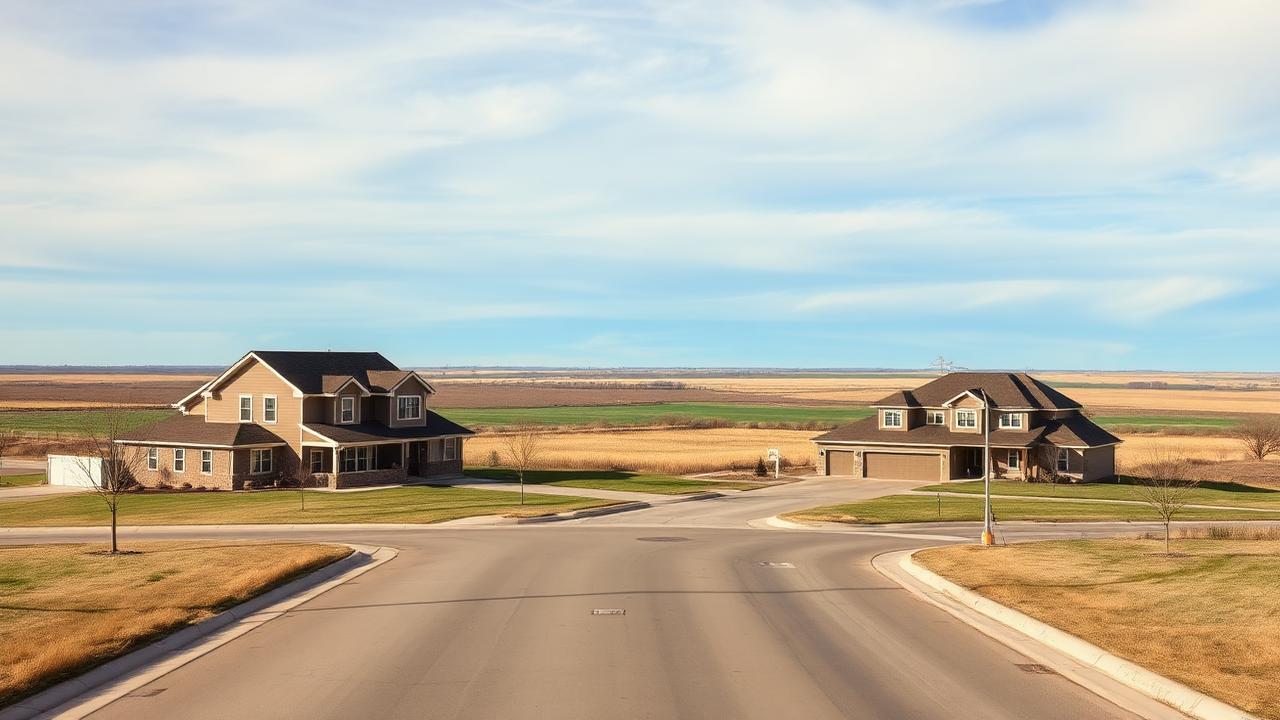
Manhattan's housing stock includes an older core near downtown and campus, mid-century neighborhoods spreading east and north, and newer subdivisions on the city's edges, particularly toward the Fort Riley side of town.
The Fort Riley connection supports a steady rental market, since incoming soldiers and their families need housing on a predictable annual cycle tied to permanent change of station moves, which gives investor-owners more consistent occupancy than many small towns can offer.
Prices remain well below the Kansas City metro, reflecting the smaller regional economy, though the university and military presence keep the market from the deep troughs a purely rural Kansas town might see.
Work and the local economy
Kansas State University is the city's largest employer, with faculty, staff, and research positions across agriculture, veterinary medicine, engineering, and other programs. Fort Riley, though technically in neighboring Geary County, draws heavily on Manhattan for housing, retail, and services and functions as a second major economic anchor.
Healthcare, led by Ascension Via Christi's Manhattan hospital, and the local school district round out the next tier of employment.
Outside of the university, the post, and healthcare, the private-sector job market is limited, so a household needing to find new local work in a specialized field should research openings carefully before committing.
Climate and setting
Manhattan sits in the Flint Hills, a region of rolling, tallgrass-covered limestone hills that is visually distinct from the flatter wheat country to the west. Summers are hot and humid, winters are cold with periodic snow and ice, and spring brings the same severe thunderstorm and tornado risk found across eastern Kansas.
Wind is a near-constant presence across the Flint Hills, and prescribed burning of the tallgrass prairie each spring is a regional practice that can bring smoke into town on burn days.
As elsewhere in eastern Kansas, humidity and severe spring weather are the main adjustments for someone coming from California.
Getting around, care, and schools
- Commercial air
- Manhattan Regional Airport (MHK) offers limited daily service; Kansas City International, about two hours east, is the practical airport for most other destinations.
- Highways
- US 24 and Kansas 18 provide the primary regional connections; Interstate 70 is about 15 miles south via US 77.
- Hospital
- Ascension Via Christi Hospital Manhattan.
- Public schools
- Manhattan-Ogden USD 383.
- Higher education
- Kansas State University, based in the city.
- Setting
- College and military town in the Flint Hills, about two hours west of Kansas City.
The trade-offs
- The private-sector job market outside the university, Fort Riley, and healthcare is narrow.
- Air service is limited, and a Kansas City International trip is a real two-hour drive for most other destinations.
- The rental market cycles with the academic calendar and Fort Riley's permanent change of station season, which affects turnover and availability.
- Spring prairie burning and severe weather are seasonal facts of life in the Flint Hills.
Other Kansas towns people compare
Overland Park
The Kansas City metro's premier suburb, with the deepest professional job base in the state and the state's best-regarded public schools.
Olathe
Newer construction at lower prices than Overland Park, in the same Johnson County school system, west of the Kansas City core.
Lawrence
Home to the University of Kansas, the state's most walkable downtown, and its most politically liberal city.
Lenexa
Master-planned growth on the western edge of the Kansas City metro, with strong municipal services and steady development standards.
Wichita
The lowest cost of living of any real Kansas market, and the state's largest city, anchored by aircraft manufacturing.
Statewide figures, tax detail, and the full Kansas picture are on the Kansas page. Compare property, income, and sales tax across all 49 destination states on Taxes, and see where Californians are actually moving on Stats.
Sources
- US Census Bureau, American Community Survey 2020 to 2024 5-Year Estimates, table B25077 (median home value), retrieved via Census Reporter, September 3, 2026.
- US Census Bureau, ACS 2020 to 2024 5-Year Estimates, table B25103 (median real estate taxes paid, owner-occupied units with a mortgage), retrieved September 3, 2026.
- US Census Bureau, ACS 2020 to 2024 5-Year Estimates, table B25088 (median selected monthly owner costs, owner-occupied units with a mortgage), retrieved September 3, 2026.
- US Census Bureau, ACS 2020 to 2024 5-Year Estimates, table B01003 (total population), retrieved September 3, 2026.
- Census Reporter, Manhattan, KS profile, censusreporter.org.
- Manhattan Area Chamber of Commerce, Manhattan At-a-Glance, madeformanhattan.org.
- Ascension Via Christi company profile, LinkedIn.
See what your California equity buys in Manhattan
Four short questions. We match you with one local agent and apply a closing cost credit funded from our referral fee.
Start your Manhattan move
Four short questions. We use them to decide which agent fits your move, and to build your equity report.