
Missouri city guide
Moving From California to Columbia, MO
A university town roughly midway between Kansas City and St. Louis, home to the University of Missouri and the state's deepest healthcare access relative to its population.
Housing comparison
California versus Columbia, side by side
- Median home value
- $725,800
- not available
- Median annual property tax
- $5,114
- not available
- Median monthly cost, owners with a mortgage
- $2,844
- not available
- Population
- 39.0 million (state)
- 130,913
Figures are US Census Bureau American Community Survey 2020 to 2024 5-Year Estimates for the city place. Property tax and monthly cost rows cover owner-occupied units with a mortgage, so they describe what current owners pay, not what a new buyer would pay at today's prices. California column is the statewide baseline used across this site.
Why Californians look at Columbia
Columbia sits almost exactly halfway between Kansas City and St. Louis on Interstate 70, and its identity is inseparable from the University of Missouri, the flagship campus of the state system, along with two smaller universities in Stephens College and Columbia College. That concentration of higher education gives the city a younger, more educated population than most Missouri cities its size.
The university's presence pulls a major academic medical center into a mid-size city, which is why Columbia has an unusually deep healthcare system for its population, anchored by University of Missouri Health Care and Boone Hospital Center. That medical density is one of the city's most distinctive practical advantages.
For a California household, Columbia offers a walkable downtown near campus, a genuinely more liberal-leaning civic culture than most of the rest of the state, and a central location that makes both Kansas City and St. Louis reachable in under two hours, in exchange for a smaller-city job market outside education and healthcare.
Columbia fits you if
- You want strong local healthcare access, including academic medical center-level care, in a mid-size city.
- You value proximity to a university culture: lectures, sports, a college-town downtown, and a younger population.
- You want a central location within driving distance of both Kansas City and St. Louis.
- You lean toward a more moderate or left-leaning civic culture than much of the rest of the state.
Look elsewhere if
- You need a broad private-sector job market outside education, healthcare, and government.
- You want direct commercial flights to major hubs; the local airport has limited service.
- You dislike a college-town rhythm, including game-day traffic and a population that shifts seasonally with the academic calendar.
- You want big-city density or nightlife; Columbia's downtown is lively but modest in scale.
Housing in Columbia
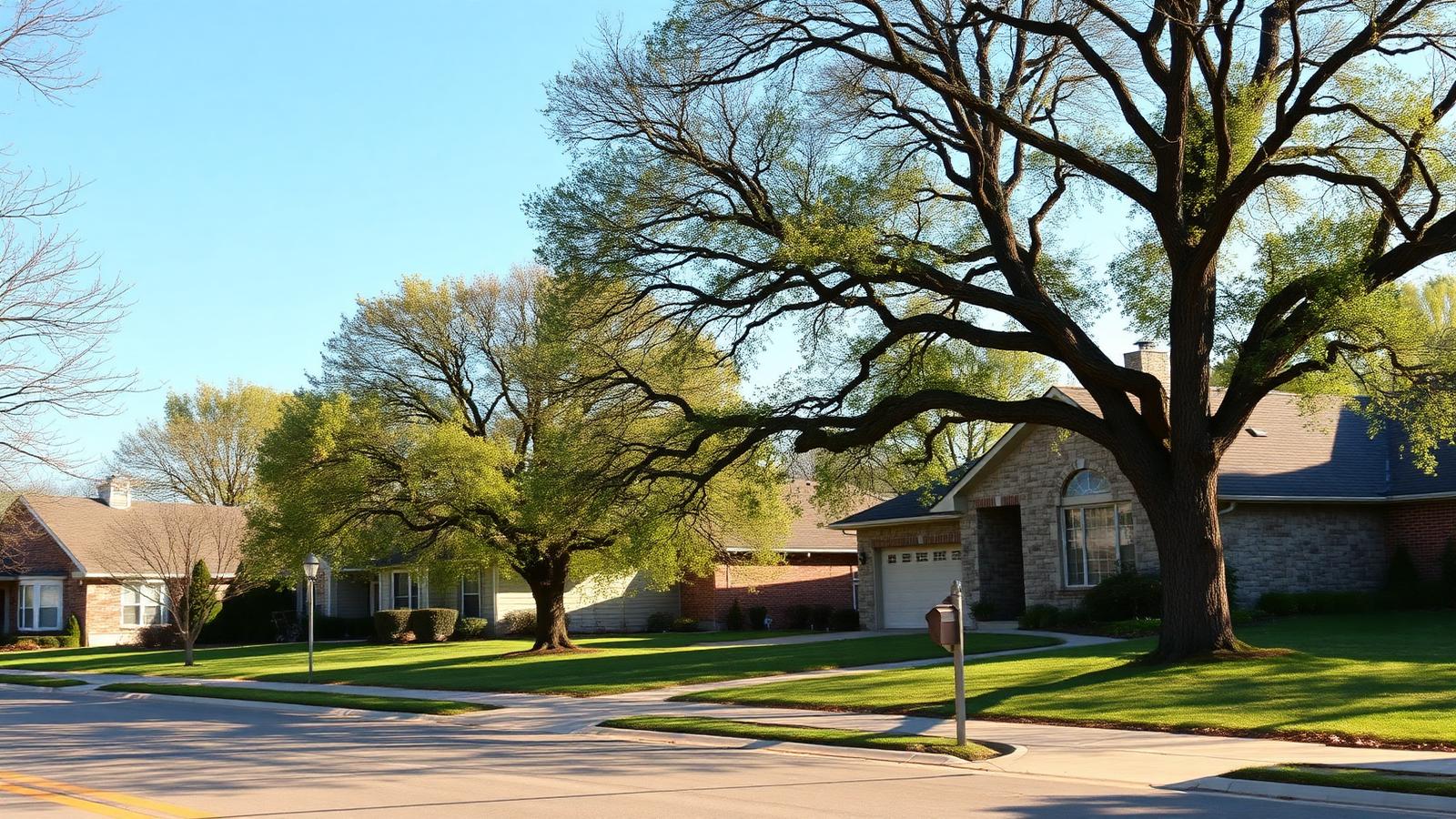
Columbia's housing stock includes historic homes near downtown and the university, and standard newer subdivisions on the city's south and east sides, with rental demand from the student population affecting the market near campus specifically.
As in the rest of Missouri, there is no California-style assessment cap, and Boone County reassesses property periodically, but tax bills remain modest relative to California by any measure.
For a California buyer, Columbia offers a genuine cost-of-living reset, with well below coastal home prices even in the most desirable neighborhoods near the university and downtown.
Work and the local economy
The University of Missouri is the city's largest employer by a wide margin, followed closely by the university's own health system, University of Missouri Health Care, and the separate Boone Hospital Center, giving Columbia an employment base weighted heavily toward education and healthcare.
State Farm Insurance operates a large regional office in Columbia, adding a corporate employer outside the education and healthcare sectors, and the city has a modest but growing biotech and agtech presence tied to university research.
Outside those anchors, the private job market is limited, and residents seeking specialized corporate or technology careers often commute or relocate toward Kansas City or St. Louis instead.
Climate and seasons
Columbia has a humid continental climate typical of mid-Missouri: hot, humid summers, cold winters with occasional ice storms and snow, and the most comfortable weather in spring and fall.
Being roughly midway between the state's two major metros and away from any large body of water, Columbia does not have a moderating influence on its weather, so summer heat and winter cold both register at their regional extremes.
Severe spring thunderstorms and tornado watches are part of the seasonal pattern here as across the rest of Missouri.
Getting around, care, and schools
- Commercial air
- Columbia Regional Airport (COU) offers limited service to Chicago and Dallas; many travelers drive to Kansas City or St. Louis for broader options.
- Highways
- Interstate 70 runs through the city; US Highway 63 provides north-south access.
- Hospital
- University of Missouri Health Care (University Hospital) and Boone Hospital Center.
- Public schools
- Columbia Public Schools.
- Higher education
- University of Missouri, Stephens College, and Columbia College are all based in the city.
- Setting
- Rolling terrain in mid-Missouri, roughly 700 to 900 feet elevation.
The trade-offs
- The private job market outside education, healthcare, and insurance is genuinely limited.
- Air service is minimal; expect to drive to Kansas City or St. Louis for most nonstop flights.
- The city's rhythm follows the academic calendar, including football game-day traffic and seasonal population swings.
- Being roughly equidistant from both major metros means neither is truly close; expect a 1.5 to 2 hour drive to either.
Other Missouri towns people compare
Kansas City
Missouri's largest city, a two-state metro with a diversified economy, an active downtown core, and housing costs far below California's.
Lee's Summit
A Kansas City metro suburb southeast of downtown, known for newer construction and the most consistent school performance in the metro.
St. Charles
A historic riverfront suburb west of St. Louis on the Missouri River, Missouri's first state capital, with steady home values and low crime.
Springfield
The largest city in southwest Missouri's Ozarks region, a university and healthcare hub with the state's lowest housing costs among its bigger cities.
Kirkwood
An established inner-ring St. Louis suburb southwest of downtown, walkable around its historic center with a Metrolink commuter rail station.
Statewide figures, tax detail, and the full Missouri picture are on the Missouri page. Compare property, income, and sales tax across all 49 destination states on Taxes, and see where Californians are actually moving on Stats.
Sources
- US Census Bureau, American Community Survey 2020 to 2024 5-Year Estimates, table B25077 (median home value), retrieved via Census Reporter, September 3, 2026.
- US Census Bureau, ACS 2020 to 2024 5-Year Estimates, table B25103 (median real estate taxes paid, owner-occupied units with a mortgage), retrieved September 3, 2026.
- US Census Bureau, ACS 2020 to 2024 5-Year Estimates, table B25088 (median selected monthly owner costs, owner-occupied units with a mortgage), retrieved September 3, 2026.
- US Census Bureau, ACS 2020 to 2024 5-Year Estimates, table B01003 (total population), retrieved September 3, 2026.
- Census Reporter, Columbia, MO profile, censusreporter.org.
- University of Missouri Health Care, muhealth.org.
- Columbia Regional Airport, flycou.com.
See what your California equity buys in Columbia
Four short questions. We match you with one local agent and apply a closing cost credit funded from our referral fee.
Start your Columbia move
Four short questions. We use them to decide which agent fits your move, and to build your equity report.