
New York city guide
Moving From California to Rochester, NY
The cheapest real housing stock of any sizable Northeast city, built on an imaging and optics engineering base that survived Kodak's decline.
Housing comparison
California versus Rochester, side by side
- Median home value
- $725,800
- $139,600
- Median annual property tax
- $5,114
- $3,152
- Median monthly cost, owners with a mortgage
- $2,844
- not available
- Population
- 39.0 million (state)
- 207,287
Figures are US Census Bureau American Community Survey 2020 to 2024 5-Year Estimates for the city place. Property tax and monthly cost rows cover owner-occupied units with a mortgage, so they describe what current owners pay, not what a new buyer would pay at today's prices. California column is the statewide baseline used across this site.
Why Californians look at Rochester
Rochester sits on the south shore of Lake Ontario in western New York, built by Eastman Kodak, Xerox, and Bausch and Lomb into one of the country's deepest concentrations of optics and imaging engineering talent. Kodak's collapse hollowed out a lot of that employment two decades ago, but the underlying research base did not disappear. The University of Rochester and Rochester Institute of Technology absorbed much of it, and a cluster of photonics, optics, and medical device firms grew around what was left.
The headline for a California household is price. Rochester's home values are the lowest of any city this size in the Northeast, low enough that a seller with ordinary California equity can buy a house outright and still have money left over. That has made the city a target for out-of-state buyers in the last few years, and prices have moved up from their post-recession floor, but they remain far below anywhere in California.
New York is not a low-tax state. There is a state income tax on wages, pensions, and most retirement income, and property tax bills reflect heavy reliance on local school and municipal levies. The trade is a genuinely cheap house against a state government that taxes income the way California does.
Rochester fits you if
- You want the lowest home prices of any real Northeast city and are comfortable in an older Rust Belt housing stock.
- You or a household member works in optics, imaging, photonics, or a related engineering field, or wants access to that job market.
- You want a full-service hospital system, two research universities, and a real airport in a metro under a million people.
- You can tolerate long, cloudy, snowy winters in exchange for cheap housing and low disaster exposure.
Look elsewhere if
- You are moving specifically for warm winters. Rochester is one of the snowiest and cloudiest cities in the country.
- You need New York City access. Rochester is roughly six hours from Manhattan by car, and there is no direct rail alternative that competes with driving.
- You expect no state income tax. New York taxes wages and most retirement income.
- You want new construction as the norm. Most of the housing stock predates 1960.
Housing in Rochester
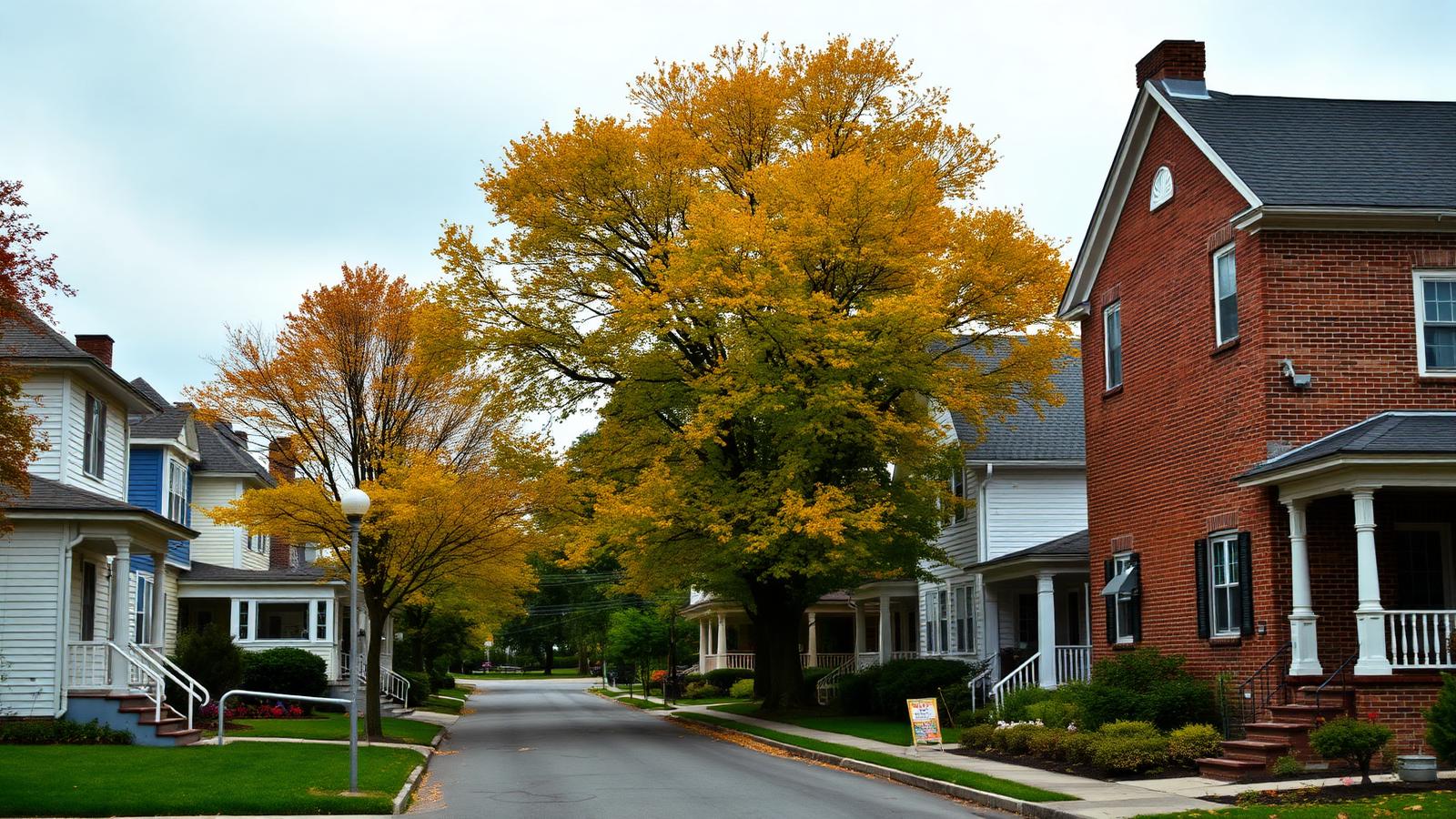
The city itself is a patchwork of early twentieth-century neighborhoods, some restored and in demand near the universities and the Park Avenue and South Wedge areas, others still recovering from decades of population loss and vacancy on the northeast and northwest sides. The surrounding towns, Brighton, Pittsford, Penfield, and Webster, carry the area's more expensive and better-maintained housing stock and its stronger school districts.
The ACS median home value for the city is $139,600, and the median annual real estate tax bill for owners carrying a mortgage is $3,152. That tax figure is not small relative to the home value, which is the pattern across upstate New York: assessed values are modest but school and municipal tax rates are high.
Because city and suburb differ so much in price and in school quality, buyers should treat 'Rochester' as a metro decision, not a single housing market. A given budget can buy very different outcomes depending on which side of the city line the address falls.
Work and the local economy
The University of Rochester, including Strong Memorial Hospital, is the largest employer in the region by a wide margin, followed by Rochester Regional Health, RIT, and a set of manufacturers descended from the old Kodak and Xerox supply chains, including Corning-adjacent optics firms and smaller photonics companies.
The metro still trains and employs a disproportionate share of the country's optics and imaging engineers, a legacy of Kodak's research culture that RIT's imaging science program and a cluster of private firms have kept alive. Outside that niche, the private-sector job market is ordinary for a metro this size.
If your income is portable, remote, or tied to the optics and photonics field specifically, Rochester's low cost of living stretches further than almost anywhere else in the Northeast. If you need to build a new career in an unrelated specialty, expect a smaller and slower local market than California's coastal metros.
Climate and lake effect
Rochester sits directly downwind of Lake Ontario, which means lake-effect snow bands add substantially to winter totals and Rochester is consistently ranked among the snowiest and cloudiest mid-size cities in the country. Winters are long, gray, and cold, with lake-effect squalls that can drop snow quickly in narrow bands while nearby areas stay clear.
Summers are short and mild, rarely brutally hot, and the lake moderates extremes in both directions. Humidity in summer is present but not oppressive by East Coast standards.
The upside of the lake and the region's inland location is very low exposure to hurricanes, wildfire, and the drought and insurance pressure that define large parts of California. Flood risk is limited to specific low-lying areas near the Genesee River, not a citywide concern.
Getting around, care, and schools
- Commercial air
- Frederick Douglass Greater Rochester International Airport (ROC) has nonstop service to roughly 17 destinations including major East Coast and Midwest hubs.
- Highways
- Interstate 490 and Interstate 390 serve the metro, with the New York State Thruway (Interstate 90) just south.
- Hospital
- Strong Memorial Hospital, the region's academic medical center, plus Rochester General Hospital.
- Public schools
- Rochester City School District within the city; surrounding suburban districts vary widely in performance.
- Higher education
- University of Rochester and Rochester Institute of Technology, both in the metro.
- Setting
- South shore of Lake Ontario, Genesee River running through downtown.
The trade-offs
- Winters bring some of the heaviest snowfall totals and least sunshine of any mid-size American city.
- New York taxes wages and most retirement income, unlike no-income-tax states.
- Property tax bills are high relative to home values, a pattern across upstate New York driven by school district funding.
- The city itself has struggled with population loss and concentrated poverty in specific neighborhoods; the strongest schools and lowest crime are mostly in the suburbs, not the city.
Other New York towns people compare
Buffalo
A revived waterfront and downtown core, a healthcare and finance-driven economy, and some of the lowest home prices among large Northeast cities.
Saratoga Springs
Upstate New York's most desirable small city, built around thoroughbred racing, mineral springs, and a walkable downtown, priced well above the rest of upstate.
Ithaca
Two colleges, deep gorges, and the most left-leaning small city in the Finger Lakes, with prices set by student demand rather than the regional market.
Beacon
A Hudson Valley arts town with a direct Metro-North line to Manhattan, popular with people who need occasional access to the city rather than a daily commute.
Kingston
Catskills access, a walkable historic core, and the small city widely credited with, and blamed for, the Hudson Valley's rising prices.
Statewide figures, tax detail, and the full New York picture are on the New York page. Compare property, income, and sales tax across all 49 destination states on Taxes, and see where Californians are actually moving on Stats.
Sources
- US Census Bureau, American Community Survey 2020 to 2024 5-Year Estimates, table B25077 (median home value), retrieved via Census Reporter, September 3, 2026.
- US Census Bureau, ACS 2020 to 2024 5-Year Estimates, table B25103 (median real estate taxes paid, owner-occupied units with a mortgage), retrieved September 3, 2026.
- US Census Bureau, ACS 2020 to 2024 5-Year Estimates, table B25088 (median selected monthly owner costs, owner-occupied units with a mortgage), retrieved September 3, 2026.
- US Census Bureau, ACS 2020 to 2024 5-Year Estimates, table B01003 (total population), retrieved September 3, 2026.
- GeoStat.org, Rochester, New York home values and property tax data drawn from the US Census Bureau American Community Survey.
- Frederick Douglass Greater Rochester International Airport, nonstop destinations, rocairport.com.
See what your California equity buys in Rochester
Four short questions. We match you with one local agent and apply a closing cost credit funded from our referral fee.
Start your Rochester move
Four short questions. We use them to decide which agent fits your move, and to build your equity report.